
 Instrument
Reference Library
Indicator Anatomy Index
DO NOT EDIT THIS FILE. It is built from the
parts[] blocks in the dossier sidecars. Add a part there, re-run build-anatomy.py, and the node appears — merged with every other dossier documenting the same part.Bezel
The rotating rim around the dial face; turned to bring the pointer to zero.
Where it is: Outer rim of the dial head.
Identifying detail: capp-verdict: DIAMOND jimping (diamond-pattern knurling) rather than straight — a distinguishing trait, and it survives onto OEM units including the Federal T-85
What each maker calls it
| no maker-specific terms recorded yet |
From the collection
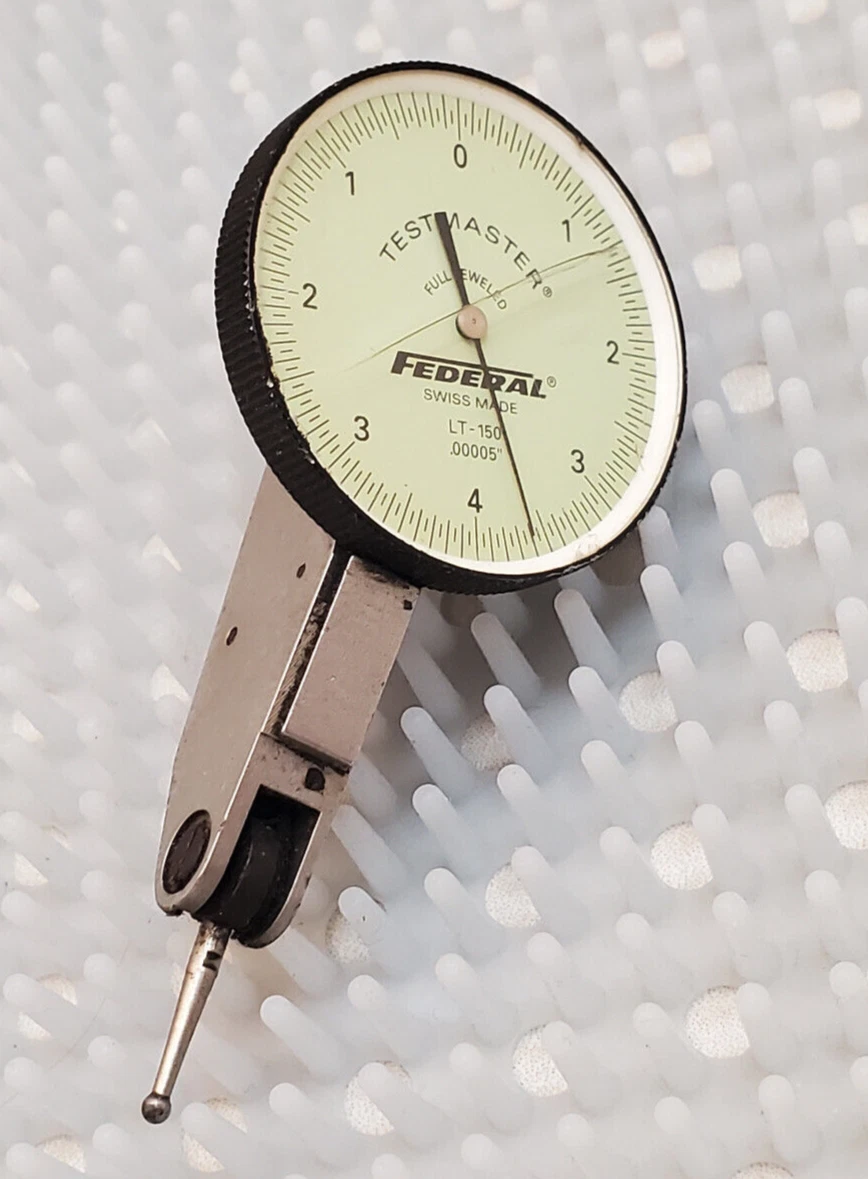
TESTMASTER · FULL JEWELED · FEDERAL · SWISS MADE · LT-150 · .00005"
Green dial (inch coding) on a Swiss-built movement. Straight bezel jimping — a clean negative for Capp. Bare body, no patent number.
REF-PAT-FED supplier unresolved
References
Documented in: REF-PAT-VDT · REF-PAT-VDT §05
Center pinion
Small gear on the hand's arbor, driven by the crown gear's inner (axial/face) tooth set; carries the dial hand.
Where it is: Movement center, on the hand arbor, between the crown gear and the hairspring gear.
Caution: Family-split part: 123089 (.0005/.001 models) vs 123097 (.0001 models incl. B-15). Not interchangeable across graduation families.
What each maker calls it
| interapid | center pinion [31] |
References
- LII Interapid spare-parts list (fetched 2026-07-22)field-report
- Kinematic chain, horizontal-model specimencollection
Documented in: REF-PRT-IAP · REF-PRT-IAP §03
Contact point (stylus)
The threaded finger carrying the measuring tip; its pivot-to-tip length sets the lever ratio and therefore the scale factor. Wrong length = wrong reading with no visible fault.
Where it is: Threaded into the stylus arm/lever at the front of the movement; removable (wrap in cloth, rotate with pliers per Mitutoyo; recalibrate after exchange).
Caution: Length datum conventions differ per house (L2 shoulder->ball vs L1 ball->thread-end vs involute working-centres). Never prescribe a point without the builder ID.
What each maker calls it
| capp-verdict | stylus / pear (involute tip, US 3,161,963) |
| compac | contact point |
| federal | contact point (INVOLUTE TIP on Providence Series 80) |
| interapid | contact point |
| mitutoyo | contact point |
| starrett | contact point |
References
- Mitutoyo Bulletin 2232(3) p.19 — external dimensions of contact pointsfigure
Documented in: REF-STY · REF-STY §01
Contact point profile (spherical vs involute)
The tip shape decides whether lever angle introduces error. SPHERICAL: tilting shortens the working-centre distance, so the reading must be multiplied by cos(A). INVOLUTE (pear/tapered): the profile shifts the contact point as the stylus tilts so the working-centre distance stays constant — NO correction factor, to about 36 degrees.
Where it is: The free end of the stylus, where it touches the work.
Caution: Do NOT apply a correction factor to an involute tip below 36 deg — that is double-correcting. Do NOT use an involute tip above 36 deg.
What each maker calls it
| capp-verdict | pear-shaped stylus / tapered free end |
| federal | involute tip contact point |
| swiss-interapid | spherical tip + 12 deg nominal, factor 1.022 |
From the collection
TESTMASTER · FULL JEWELED · FEDERAL · SWISS MADE · LT-150 · .00005"
Green dial (inch coding) on a Swiss-built movement. Straight bezel jimping — a clean negative for Capp. Bare body, no patent number.
REF-PAT-FED supplier unresolved
References
- Federal 80-Series Testmaster instruction sheet — involute tip, 36° rule, cosine tablecollection
- US 3,161,963 — the involute/pear profile construction (Figs. 3–9)patent
- US 3,161,963 — drawings, sheet 1figure
- US 3,161,963 — drawings, sheet 2figure
Documented in: REF-PAT-FED, REF-PAT-VDT · REF-PAT-FED §03e
Crown gear (conjugate-tooth)
A gear whose teeth stand on the FACE rather than the rim, transferring rotation across a right angle. Street's conjugate tooth form gives exact velocity ratio at instrument scale — a per-radius pressure angle, contact ratio >= 1.
Where it is: Movement plate, between the segment and the dial pinion.
Unique to: federal
Patent: US2141627
What each maker calls it
| federal | crown gear |
References
Documented in: REF-PAT-FED, REF-PAT-VDT · REF-PAT-FED §02
Crystal (cover glass)
The clear window over the dial. Acrylic on most vintage DTIs; GB720132-era Capp units use a glass cover.
Where it is: Under the bezel, over the dial face.
Service note: IPA contraindicated near acrylic crystals. Restoration triage: haze/swirls -> straight to polish; light scratches -> enter at 3200-4000 micro-mesh; deep gouges -> full progression.
What each maker calls it
| capp-verdict | glass cover |
References
- REF-SVC-IAP — Interapid service & repair reference (crystal & bezel, restoration)internal
Documented in: REF-PAT-VDT · REF-SVC-IAP
Dial face
The printed scale. On Federal instruments the dial is the ONE SURFACE FEDERAL ALWAYS SPECIFIED, whoever built the movement.
Identifying detail: federal: green = INCH, yellow = METRIC (Mahr: 'soft-green tint'). Colour coding is a FEDERAL system spec — it travels across suppliers and attributes NOTHING about the builder.
Caution: Do not use dial colour to attribute a maker. A Swiss-built LT-150 carries a green dial because it is an inch instrument.
What each maker calls it
| federal | dial |
From the collection
TESTMASTER · FULL JEWELED · FEDERAL · SWISS MADE · LT-150 · .00005"
Green dial (inch coding) on a Swiss-built movement. Straight bezel jimping — a clean negative for Capp. Bare body, no patent number.
REF-PAT-FED supplier unresolved
Documented in: REF-PAT-FED · REF-PAT-FED §03c
Dovetail clamping slide
Angled slot in the body casting for mounting to a holder. Verdict T31 carries dovetails on BOTH top and bottom of the casing.
Where it is: Body casting.
What each maker calls it
| no maker-specific terms recorded yet |
References
Documented in: REF-PAT-VDT · REF-PAT-VDT
Hairspring
Fine coiled spring providing return force and taking up backlash.
What each maker calls it
| no maker-specific terms recorded yet |
References
Documented in: REF-PAT-VDT · REF-PAT-VDT §03
Hairspring gear
Gear carrying the coiled hairspring that biases the train toward zero.
Where it is: On the movement plate adjacent to the center pinion; the hairspring's outer end anchors to the peg [37].
Caution: Family-split: 123091 (.0005/.001) vs 123099 (.0001 AND B-15). Note the hairspring itself splits three ways (123092 / 123100 / 123242) — gear and spring do not share a split pattern.
What each maker calls it
| interapid | hair spring gear [33] |
References
Documented in: REF-PRT-IAP · REF-PRT-IAP §03
Hand / pointer
The indicating needle.
Behaviour: ON A FEDERAL-BUILT UNIT THE HAND REVERSES WITH STYLUS SENSE (gear train). If it does NOT — if it sweeps the same way whichever way the stylus deflects — the instrument was built by A. Capp & Son and Federal only printed the dial.
Identifying detail: capp-verdict: hand-and-hub design distinctive; survives onto OEM units
What each maker calls it
| federal | hand |
| uk | hand, needle |
| us | hand, pointer |
References
- Verdict T31 (01/3031) — 'automatic reversal movement', 'unidirectional hand travel'maker
- Model Engineer forum — users misreading the one-turn biased travel as a faultfield-report
Documented in: REF-PAT-FED, REF-PAT-VDT · REF-PAT-FED §03d
Helix (helix-drive)
Converts stylus lever motion to pointer rotation via a helix carried on the pointer shaft, with the lever's extension riding BETWEEN adjacent turns. No gear teeth, no train, no accumulated backlash. Amplification is set by the helix pitch alone.
Where it is: On the pointer shaft, on the movement plate, once dial and bezel are removed.
Unique to: capp-verdict
Patent: GB720132
Caution: Unidirectional hand travel proves a SCREW-TYPE TRANSFER, not a coil. A machined worm behaves identically. Also unresolved: whether later units retain the direct pin-on-helix topology or introduced a worm WHEEL.
What each maker calls it
| capp-verdict | helix / 'coil-type worm spiral' |
References
- GB 720,132 — Capp & Son, the helix mechanism (full spec)patent
- GB 468,243 — the 1937 founding patent (parent spec)patentNOT YET READ — see Q9
Documented in: REF-PAT-VDT · REF-PAT-VDT §03
Jimping (knurling pattern)
Grip texture cut into the bezel rim.
Variants: straight: most makers; diamond: Capp/Verdict — identifying trait
What each maker calls it
| no maker-specific terms recorded yet |
From the collection
TESTMASTER · FULL JEWELED · FEDERAL · SWISS MADE · LT-150 · .00005"
Green dial (inch coding) on a Swiss-built movement. Straight bezel jimping — a clean negative for Capp. Bare body, no patent number.
REF-PAT-FED supplier unresolved
Documented in: REF-PAT-VDT · REF-PAT-VDT §05
Mounting ring (bezel attaching inner ring)
Threaded inner ring fixed to the case; the bezel screws onto it. The part held steady via the two underside holes during bezel removal.
Where it is: Under the bezel, at the case mouth.
Caution: Universal across all 312 (123081).
What each maker calls it
| interapid | mounting ring [41] |
References
- LII Interapid spare-parts list (fetched 2026-07-22)field-report
- LII crystal installation instructions (bezel-removal procedure)field-report
Documented in: REF-PRT-IAP · REF-PRT-IAP §03
Movement plate
The flat plate the mechanism is built on. The diagnostic surface: mechanism family is identifiable at a glance once exposed — helix, sector, or crown gear.
Where it is: Beneath the dial face; reached by removing bezel, crystal and dial.
What each maker calls it
| capp-verdict | cover plate (removed to expose internal mechanism) |
References
Documented in: REF-PAT-VDT · REF-ANA
Pinion
The small gear on the pointer shaft, driven by the sector or crown gear. The last amplification stage.
What each maker calls it
| federal | involute spur pinion |
| swiss | pinion |
References
Documented in: REF-PAT-FED, REF-PAT-VDT · REF-PAT-FED §02
Reversing lever / direction-change lever
External lever flipping which direction the instrument reads.
Where it is: External, beneath the dial face.
Failure mode: moulded plastic on many Capp/Verdict units — well-attested breakage. Field fix: shaped springy steel or brass sheet. Underlying chamfered friction washer holds the setting.
Caution: PRESENCE OF A REVERSING LEVER DOES NOT IDENTIFY THE MAKER — Street's own patent embodiment has one. Only the HAND-TRAVEL BEHAVIOUR discriminates.
What each maker calls it
| capp-verdict | switch lever |
| federal | external reversing handle |
References
- US 2,141,627 — external reversing handle in the DTI embodimentpatent
- Model Engineer forum — repairing a Verdict DTI: broken plastic lever, friction washer, field fixfield-report
Documented in: REF-PAT-FED, REF-PAT-VDT · REF-PAT-FED §02
Sector (toothed segment)
A curved, toothed segment of a gear — a gear 'pie slice' — amplifying the small swing of the stylus lever into a large pointer sweep.
Where it is: Movement plate, meshing the pinion on the pointer shaft.
What each maker calls it
| federal | segment |
| kaefer | Zahnsegment |
| starrett | sector |
| swiss | sector gear |
References
- US 2,141,627 — the DTI train: friction two-part stylus lever, segment, pinion, crown gear, dialpatent
Documented in: REF-PAT-FED, REF-PAT-VDT · REF-PAT-FED §02
Spigot / stem
Cylindrical stem for clamping. Capp/Verdict: 1/4 inch imperial, 4mm metric; swivel spigot standard.
Where it is: Rear or top of the body.
What each maker calls it
| uk | spigot |
| us | stem |
References
Documented in: REF-PAT-VDT · REF-PAT-VDT
Stylus (contact point)
The contact arm that touches the work.
Where it is: Projecting from the body; swivels through 180 degrees on most makers.
Variants: spherical: standard ball tip. Tilting the stylus shortens the working-centre distance -> reading error growing with angle. Corrected procedurally (Interapid: nominal 12 deg, factor 1.022).; pear-tapered: Capp's profiled tip (US3161963). Taper holds the horizontal working-centre distance CONSTANT at all tilts. Profile is a roulette traced by a point on a rolling disc. 0.306 in working centres, 0.115 in tip diameter. Federal calls this an INVOLUTE TIP CONTACT POINT and instructs users to apply NO correction factor below 36 deg — reprinting Capp's patent limit.
What each maker calls it
| capp-verdict | stylus / feeler |
| federal | contact point |
| kaefer | Taster |
| swiss | stylus |
References
- Federal form A-712 — Testmaster Series 80 contact point sheet (1980, 1144 Eddy St)collection
- US 3,161,963 — Desmond Capp, tapered styluspatent
Documented in: REF-PAT-FED, REF-PAT-VDT · REF-PAT-FED §03e
Stylus ratchet
Toothed detent letting the stylus be tilted and held in indexed steps. Capp: 30 teeth at 12-degree spacing, so the stylus indexes at 0/12/24/36 degrees. A friction connection is offered as an alternative in the patent.
Where it is: At the stylus pivot / screw pivot.
Patent: US3161963
What each maker calls it
| capp-verdict | ratchet tooth connection |
References
Documented in: REF-PAT-VDT · REF-PAT-VDT §04
Working centres
The two reference points whose separation governs a lever DTI's reading: the stylus PIVOT centre, and the CONTACT POINT of the tip on the work. If tilting the stylus changes the distance between them, the instrument lies.
What each maker calls it
| capp-verdict | working centres |
References
Documented in: REF-PAT-VDT · REF-PAT-VDT §04