 Instrument
Reference Library
The Last Word Test Indicator
H. A. Lowe → L. S. Starrett 711
Where the design comes from
The "Starrett" Last Word is a Cleveland design with Waltham watchmaking roots. Every instrument in this family — Lowe-marked, transition hybrid, or modern 711 — runs the same mechanism: a spiral (helical) groove cut into the pointer spindle, driven by a tooth on the stylus lever. No gear train. That single design decision explains both its low cost and its century-long reputation for stick-slip.
Lowe's indicator patents — four known
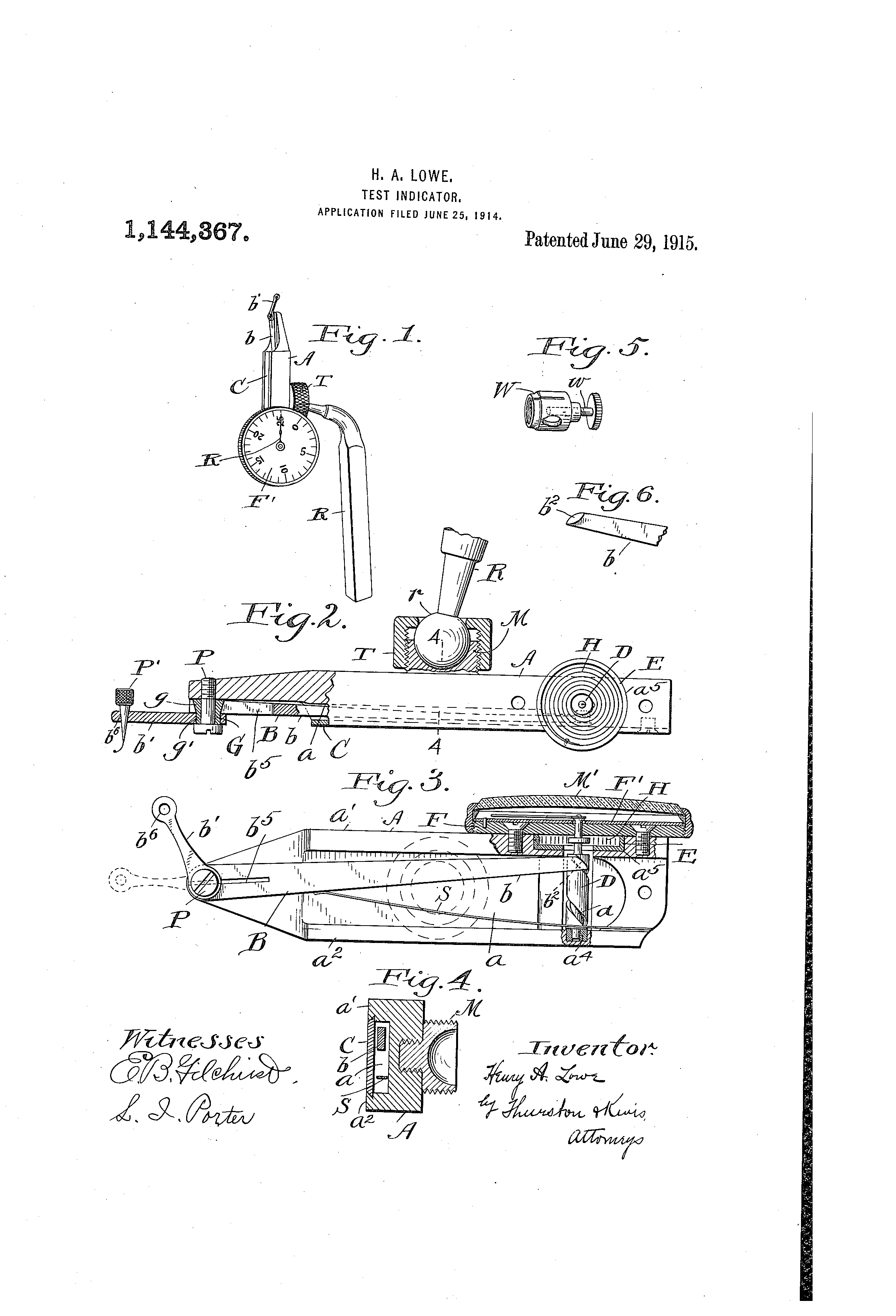
All four are pre-1929 US patents and therefore public domain. PDF links go directly to the Google Patents scan of the original document. REV B correction: REV A declared three patents “complete” per DATAMP’s H. A. Lowe record; a fourth (US 1,585,778) surfaced via the patent stamp on an early Athol-production Starrett 711C, and the count is now stated as “known,” not exhaustive.
What it covers
- The helix-and-tooth drive: a spindle carrying the pointer has a spiral groove cut into it; the long arm of the stylus lever carries a tooth riding in that groove. Lever arc → spindle rotation, with no gears. Claimed amplification: pointer motion 100× the stylus deflection.
- Dial spec as patented: graduated 0–25, each division = .001" at the contact point.
- Adjustable two-piece lever: the contact arm grips a tapered bushing friction-tight (slit-clamp), so the stylus can be swung to different angles relative to the body — the swiveling-contact behavior every Last Word owner knows.
- Return system: fine spiral hairspring in an adjustable friction-fit spring barrel (pure watchmaking construction) returns the spindle; a separate leaf spring returns the lever. Single-direction action only — no reversing yet.
- Mounting: threaded rear boss with hemispherical socket for a ball-ended tool-post shank; clamp accessory for surface-gage spindles; tapered hole in the stylus tip accepts a bent-wire point for small bores.
Documents
 Click to zoom
What it covers
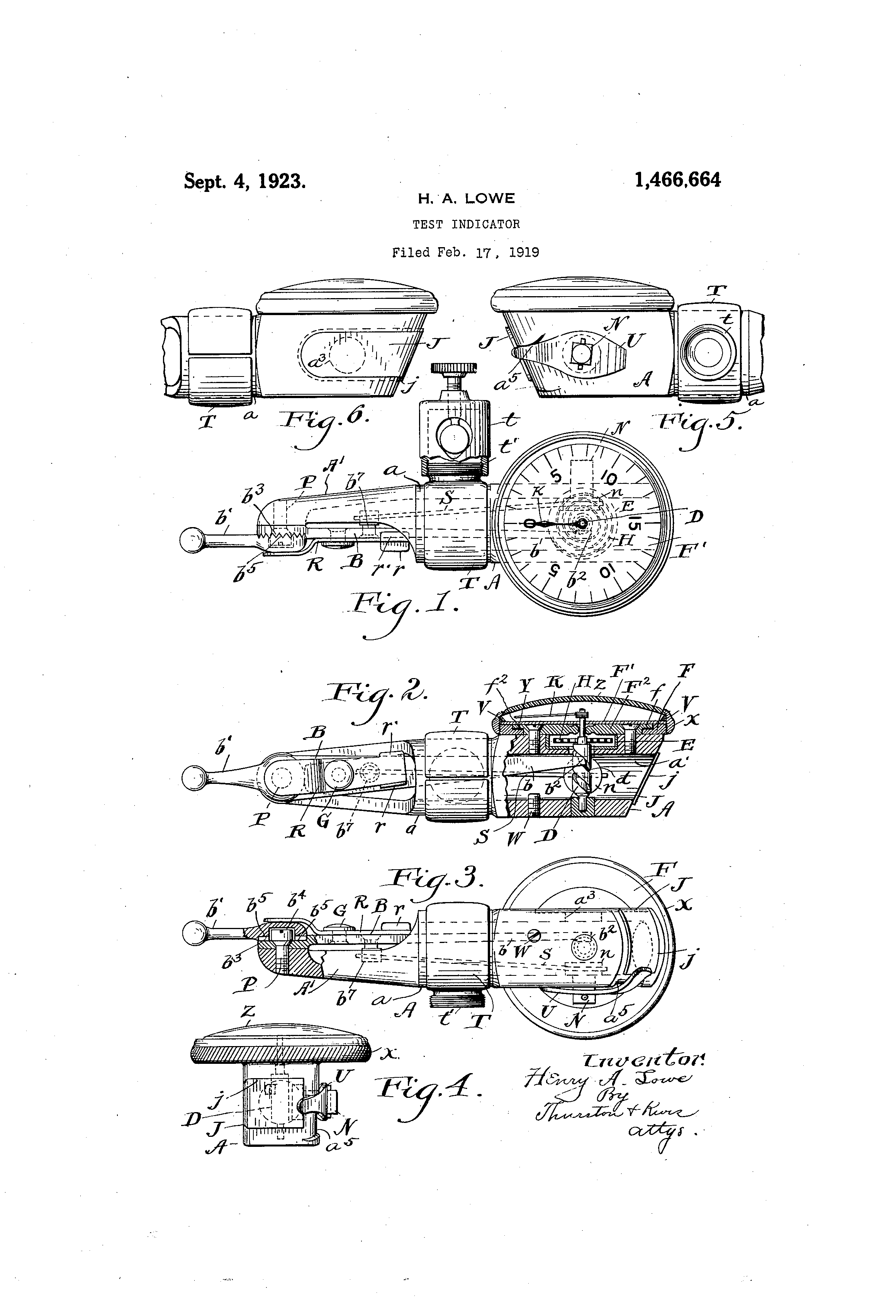
- The tubular body: claims an "integral tubular body having a tapered fore-end and a cylindrical portion" — the definitive round Last Word silhouette, unchanged to this day.
- The reversing mechanism: a small rotating shaft carries a delicate wire spring threaded through a stud on the operating lever; flipping the external lever between two notch positions reverses which direction the spring biases the stylus. This is the ancestor of the modern 711's reversing switch, and the dial is graduated both ways from 0 to suit it.
- Serrated stylus joint: the contact arm and lever arm mate through complementary annular radial serrations held by a spring latch — indexed, non-slip stylus angle adjustment, fixing the friction-joint drift problem of the 1915 design (the patent says so explicitly).
- Rotating bezel: dial ring rides on a corrugated spring friction washer under a screwed-on bezel — the zero-set bezel, described in full watch-case vocabulary (bezel, crystal).
- Rotatable clamp ring: a friction spring ring with threaded boss turns about the cylindrical body — the swiveling-body mounting versatility Starrett still advertises.
Documents
 Click to zoom
What it covers
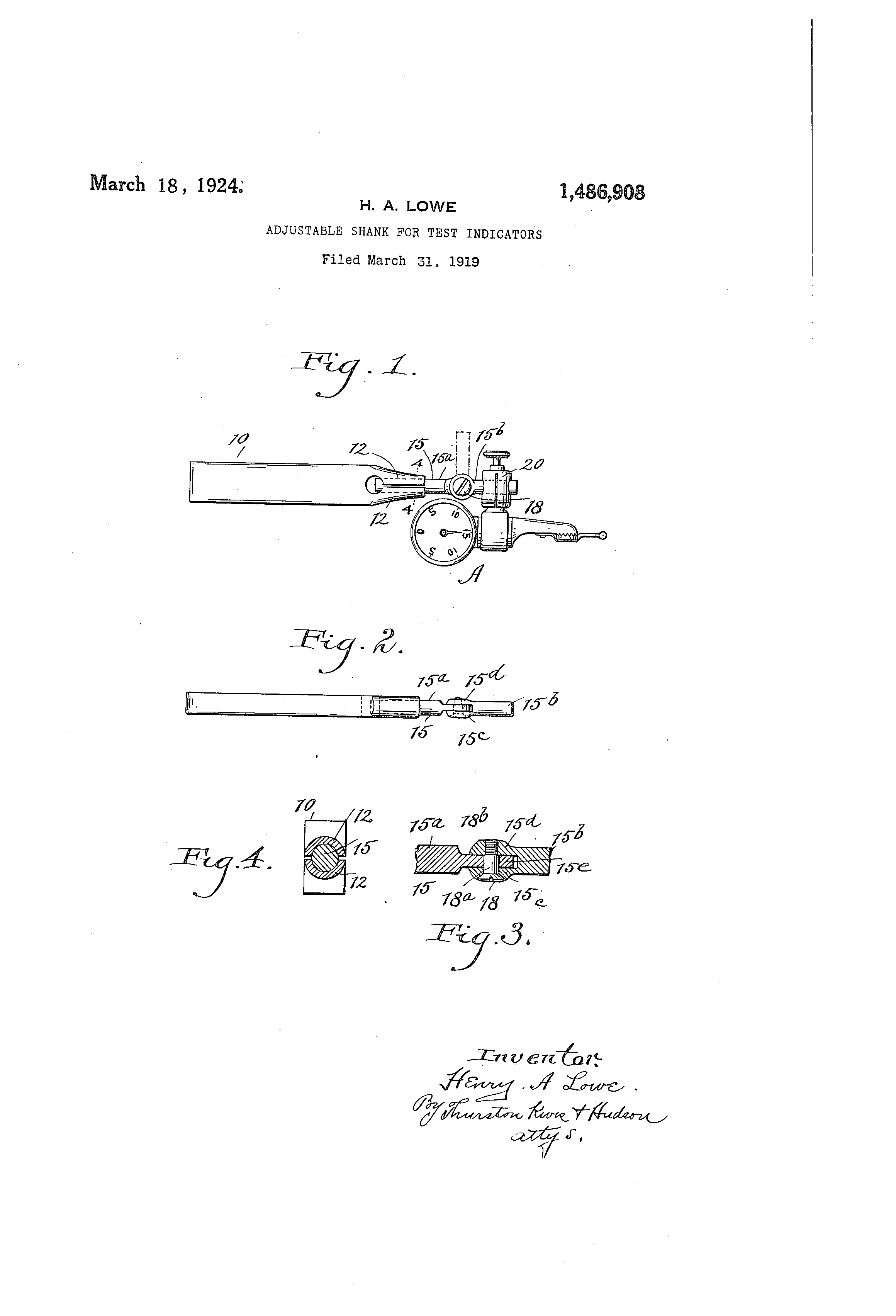
- A tool-post shank ending in spring clamping jaws with a longitudinal recess, holding a two-arm shank extension: two cylindrical arms pivoted together, one friction-fit in the jaws, with the indicator attachment rotatably clamped on the other arm.
- In plain terms: the articulated snug/attachment hardware that lets the indicator body swing and clock into "an almost infinite number of positions" off a lathe tool post — the direct ancestor of the attachment kit that ships in every 711 "complete with attachments" set.
Documents
 Click to zoom
What it covers
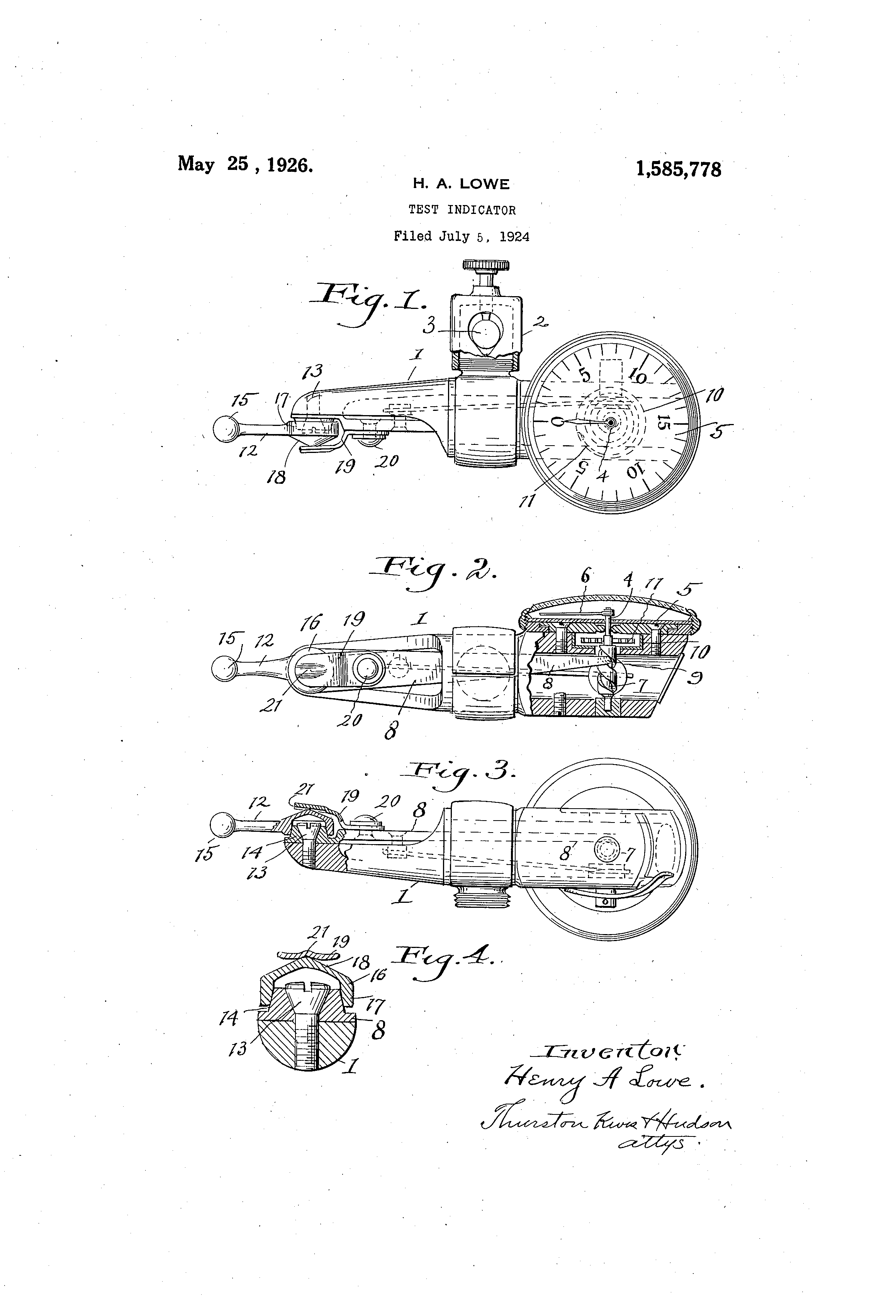
- A joint that is both detachable and infinitely adjustable: the contact arm seats on a shallow (~5°) conical boss coaxial with the pivot, retained by a spring clip — quick-change arms with stepless angular setting.
- The specification explicitly critiques its two predecessors: the 1915 friction joint adjusts smoothly but cannot detach; the 1923 serrated joint detaches and locks positively but only in discrete tooth-steps. This patent resolves both — the direct ancestor of interchangeable 711 contact points.
- Body stated as "identical in construction" to the US 1,466,664 round tubular housing.
Documents
 Click to zoom
Marking → production-window cross-reference
Patent stamps date instruments the way battery types date Starrett digital mics. Windows below are inferred from grant dates, the 1935 acquisition, and documented transition pieces; makers used up old stock, so treat boundaries as soft by a year or two.
| Marking / configuration | Window | Reading |
|---|---|---|
| "Patents Pending" only, long body (6½"), rear scale | 1902–c.1908 | Waltham/early Cleveland prototype era. Genuinely rare — one documented collector search ran 35 years. |
| "Patents Pending" only, compact dial body | c.1908–1915 | Cleveland production before the first grant. |
| "Pat. June 29-15 / Others pending" | 1915–c.1923 | First patent granted, 1919 filings still pending; strictly, an application remained pending until May 1926 (US 1,585,778), so late examples may run to c.1926. Seen on Model C and D-10 flat bodies. |
| Markings citing the 1923/1924 patents; round tubular body | 1923–1935 | Late Lowe production; reversing lever present on round bodies. |
| Starrett/Athol marking with "PAT. NO. 1,585,778" as sole patent cited | 1935–c.1943 | Early Athol production; 1,585,778 was the last-expiring Lowe patent (May 25, 1943), so it rides alone on first-generation Starrett units. Documented on an early 711C. |
| Lowe-marked instrument in Starrett box, or Lowe body with Starrett dial | c.1935–1937 | Transition stock after the Athol move. Period-correct, not a marriage — often underpriced when misidentified. |
| Starrett 711 with Lowe model letters (711C, 711D-10, 711F); 710D | 1935–1960s | Starrett-era production carrying the 1931 Lowe model line forward. 711D listed as late as Catalog No. 27 (1965). |
| Shaded dial ("jig-borer"), reversing lever, attachment set | postwar→ | Mature F-configuration; feature set matches current catalog copy. |
Known lookalikes: "Lowe of Cleveland"-marked single-direction unit with .050"/turn dial and a 1904 patent date (early variant/derivative); Spot-On and certain Craftsman-branded DTIs use the same helix-and-jewel architecture but are not Starrett production. Starrett kept Lowe's model letters, so a "Model F" reference in a 1931 Lowe catalog and a "711F" are the same configuration.
Source register
- USPTO full-text scans via Google Patents: US 1,144,367 · US 1,466,664 · US 1,486,908 (all verified to name Henry A. Lowe, Cleveland OH).
- DATAMP (Directory of American Tool & Machinery Patents) — H. A. Lowe manufacturer record and patent 1,144,367 entry with instrument photos and marking transcription.
- Encyclopedia.com corporate history of L. S. Starrett Co. — 1935 acquisition of the Henry A. Lowe Co. Last Word business and relocation to Athol.
- Practical Machinist, Antique Machinery & History forum — 1902 Lowe indicator thread (Waltham origin, 1907 Cleveland move, three-patent count, 1931 catalog models C/D-10/F, transition hybrids, Spot-On mechanism note).
- Quality Magazine / Starrett, "The World of Indicators" — John Logan, May 15, 1883 first indicator patent (patent number not independently verified in this dossier).
- Starrett current catalog copy for 711 feature set continuity.
Related documents
Links resolve within the reference/ tree (dossiers/<family>/ layout). Cross-references also carried in each JSON sidecar as relatedDocs.