 Instrument
Reference Library
The Gladwin .020″ Test Indicator
A. G. Winters — Flint, Michigan
Winters, Toledo → Flint
"Gladwin" is a trade name, not a company lineage: DATAMP records the manufacturer of both patents as A. G. Winters of Flint, MI — the inventor built and sold his own instrument. Alfred G. Winters filed his first indicator patent from Toledo, Ohio in 1932, then relocated to Flint — the heart of GM production — where the second patent was filed and the "GLADWIN / Flint, Mich." instruments were made. Where the Last Word is a Waltham watchmaker's mechanism (helix, hairspring, jewel), the Gladwin is Depression-era auto-industry pragmatism: stamped-plate construction, dual-arm direction reversal with no reversing lever, and a body slim enough to read a bore from inside it.
The two Winters patents
Both are Winters' individual patents (no assignee), prosecuted by the same Toledo attorney, George E. Kirk. Both are expired US patents in the public domain; PDF links go to the original USPTO scans.
What it covers
- The twin pointer (claim 6 verbatim category): a pointer lever ending in a pair of pointers whose tips overhang beveled graduations on both faces of the housing — the spec is explicit that readings "may be readily had from different directions," including end-on. This is the dual-side reading owners remark on, and the always-one-side "red pointer" behavior is this twin-pointer geometry at work.
- Direction-agnostic response: the contact arm is friction-clamped to a lever whose two offsets straddle the pointer-lever fulcrum, so the pointer throw "will always be the same … regardless of the direction of the movement" — automatic reversal with no reversing lever, a decade before most shops saw a Swiss DTI.
- Fan-form housing with a rockable interlocking lid (tongue into undercut seat), friction-adjustable contact-arm angle, and a replaceable contactor tip seated in the arm.
- Range as patented: a scale of roughly 1" showing 20/1000" — the marked .020" range.
- The mounting ecosystem: drill-spindle taper adapters, a radial extension rod for large-diameter work, a spring-relieved reciprocable plunger extension (converting the lever instrument into a plunger-mode indicator), lathe/planer fixture use, and tool-post clamp mounting.
Documents
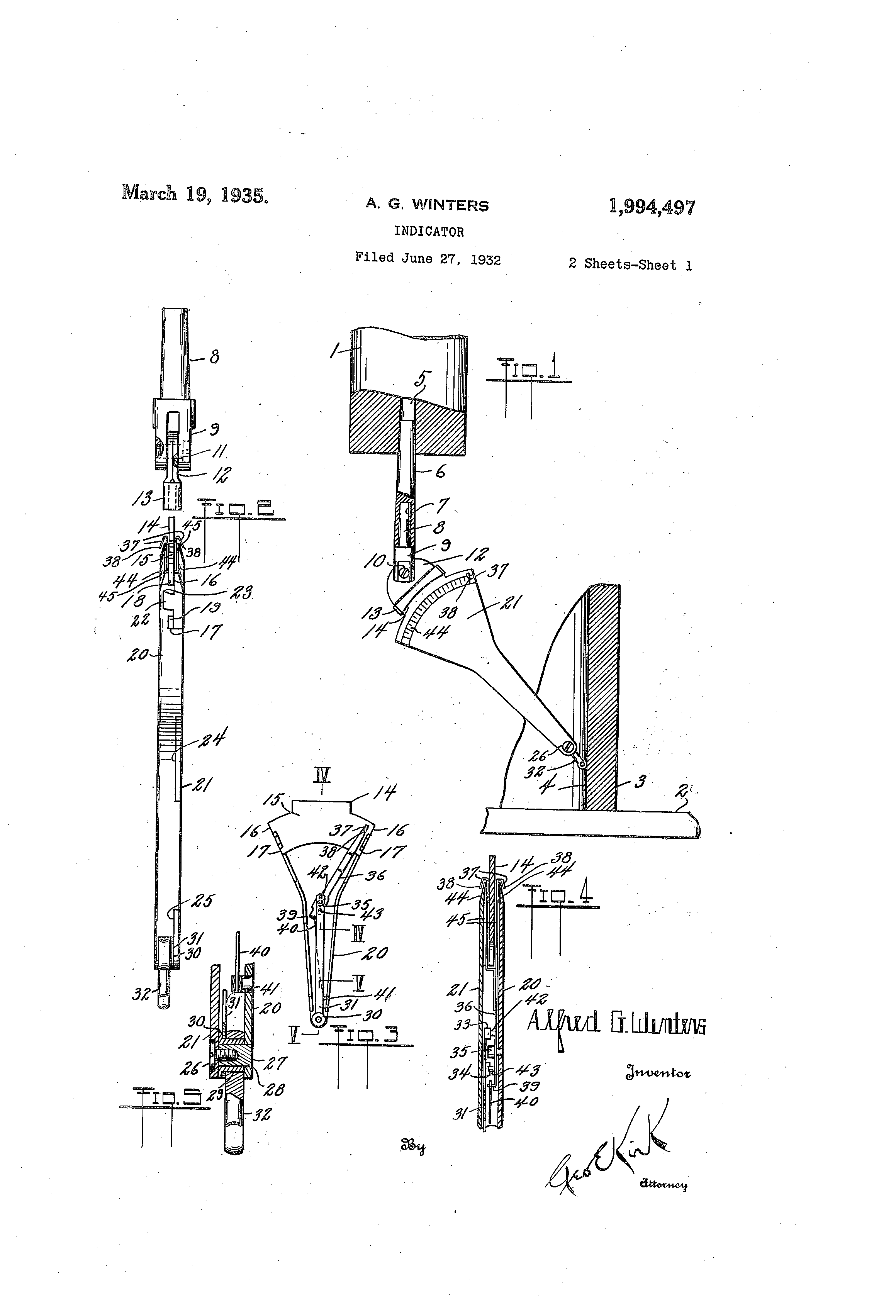 Click to zoom
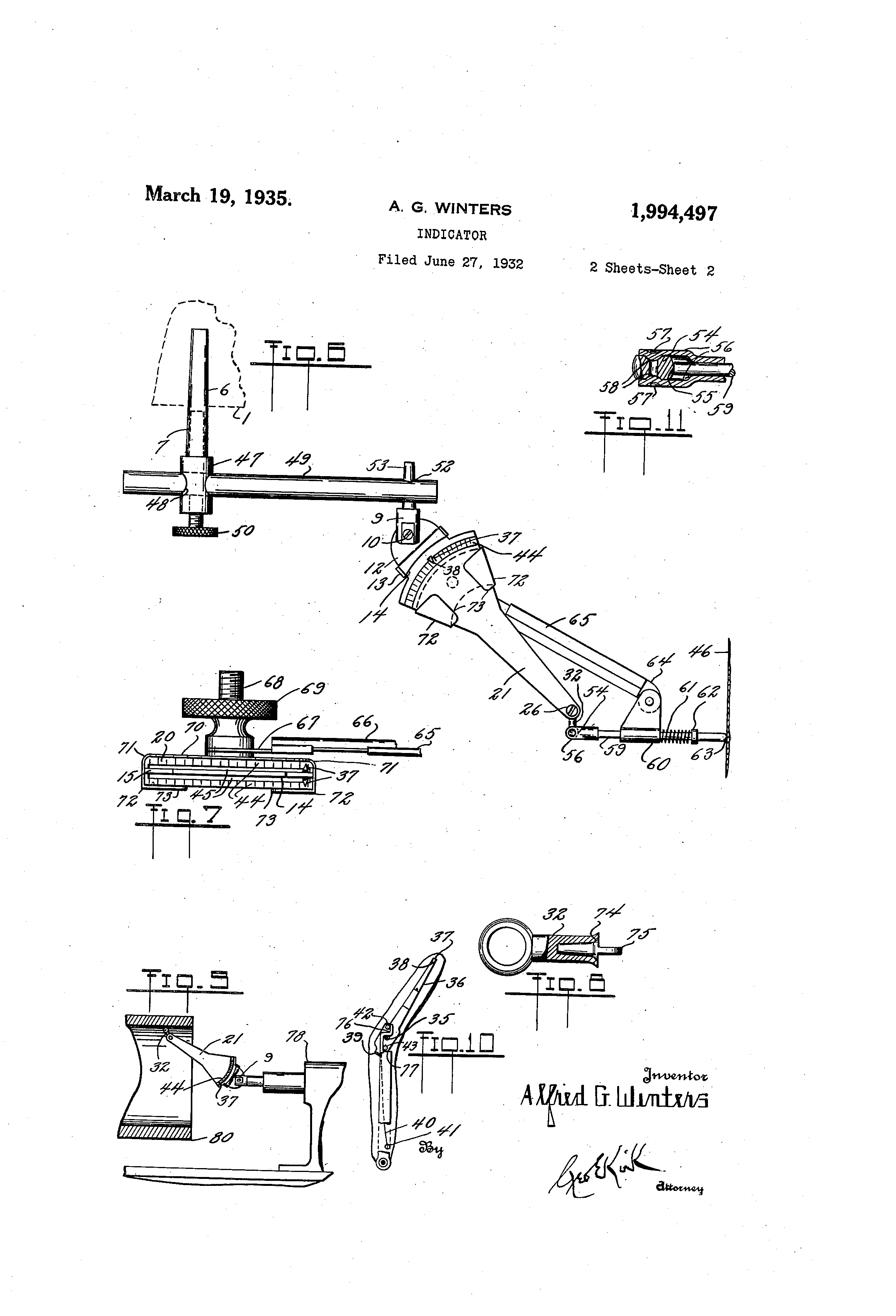 Click to zoom
What it covers
- The dual-arm reversal mechanism, formalized: claims 1–4 all center on a pair of diverging transmission arms from a common pivot on the contactor lever — one arm drives the pointer in each direction of stylus movement, "wholly within the housing." This is the heart of the production Gladwin and its cleanest engineering distinction from the Last Word, whose reversal needs a manual flip lever.
- Stamped two-piece fan frame assembled by interlocking tongues and recesses plus a single fulcrum screw — tooling-light, Depression-appropriate manufacture.
- Reach as a design goal: the spec boasts operation in bores as small as 3/16" internal diameter, with a frame about 3" long and ¼" wide at the pointer end — the "king of getting into small places" reputation, in the inventor's own numbers.
- The accessory system: frame-embracing clamp with knurled nut, directing handle, telescoping offset and straight termini, clamp-connected point/ball/offset tips, a steadying work-rest finger, a wiggler-style spring center-finder bracket for lathe/mill/drill setups, and a zero-notch for reading while the work rotates.
Documents
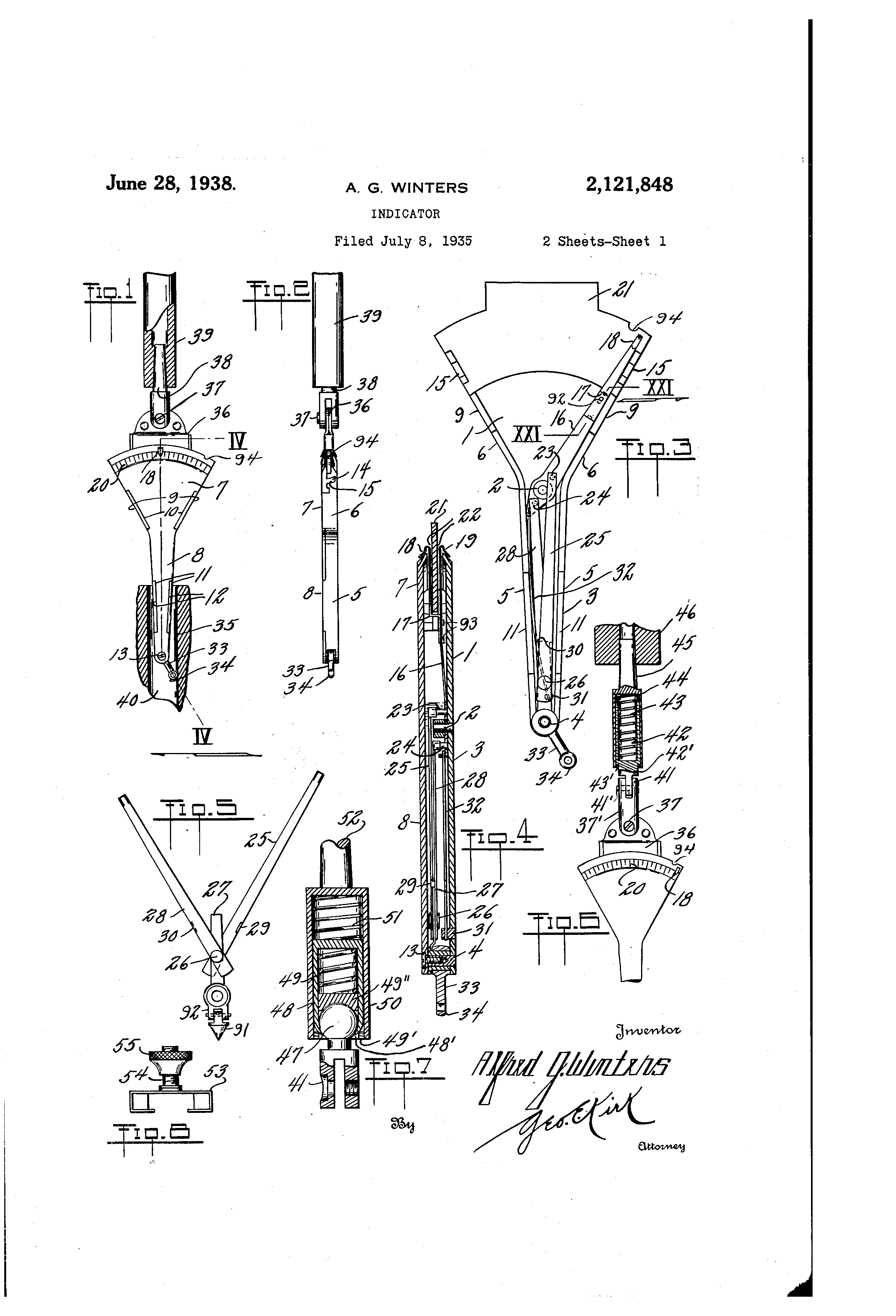 Click to zoom
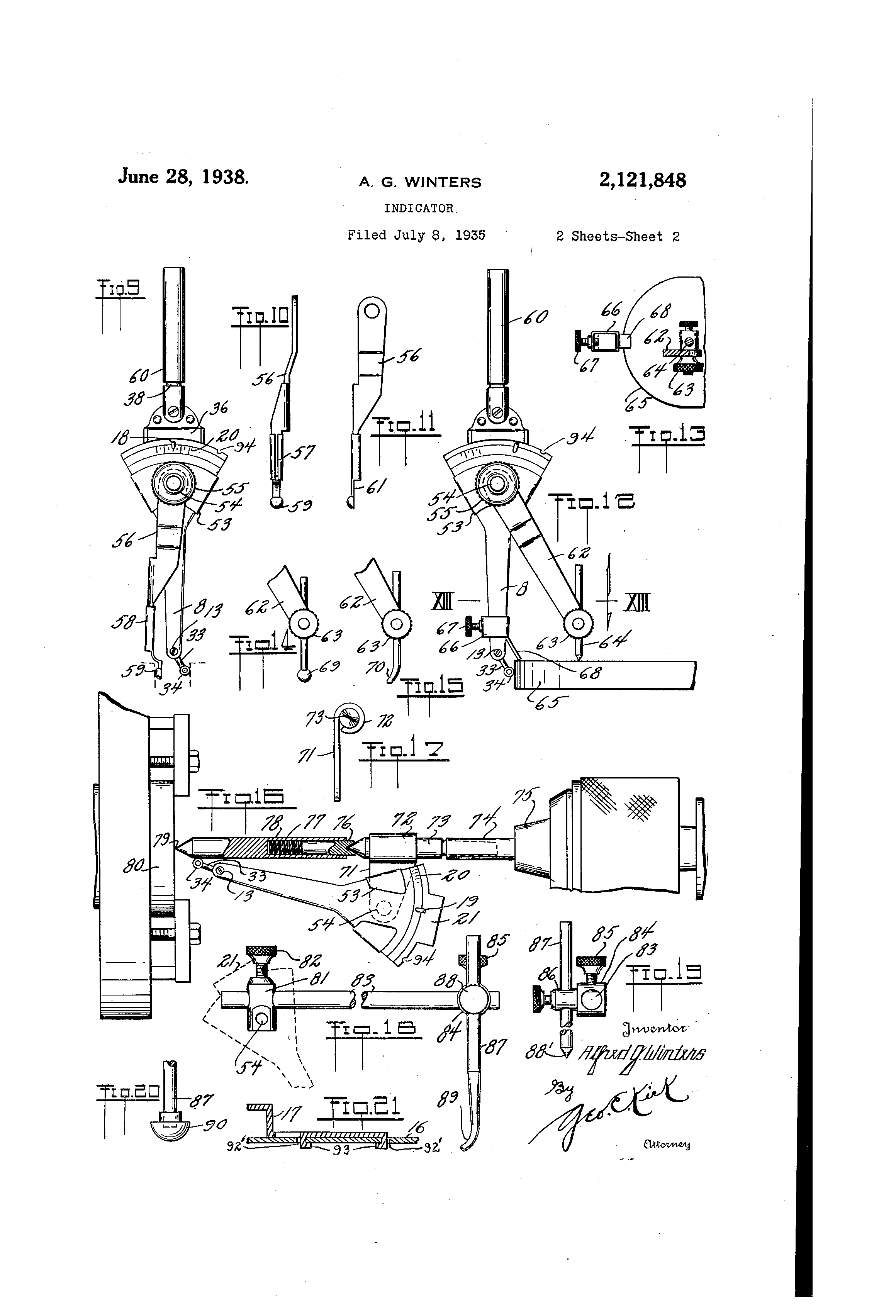 Click to zoom
Marking → production-window cross-reference
The Gladwin marking record is far thinner than the Lowe/Starrett one — the windows below are inferred from patent dates and the single documented marking pattern. Side-by-side unit comparisons (fonts, castings, tip styles) are genuinely uncharted territory.
| Marking / configuration | Window | Reading |
|---|---|---|
| "1,994,497" only (no second number) | 1935–1938 | Hypothetical earliest marked production; second patent still pending. Undocumented — photograph and record if found. |
| "GLADWIN / Flint, Mich." + both US numbers; "CAN. PAT'D 1936 / .020″" on reverse | 1938 – early 1950s | The documented standard marking (DATAMP examples). The 1936 date is the Canadian patent, not the model year. |
| Unmarked Gladwin-pattern unit | unresolved | Stripped/re-finished unit, contract sibling, or copy — compare frame stampings, dial font, and tip clamp against a marked example. |
Bench notes: the ball and point tips are clamp-connected accessories (Figs. 12–15 of the 1938 patent) and are the common casualty — the folk wisdom that Gladwins "don't like rags" refers to snagging these termini. The dual-arm movement has no helix to gum; sticking usually traces to the friction clamp or fulcrum pivots rather than a Last Word-style lubricant failure.
Source register
- USPTO full-text scans via Google Patents: US 1,994,497 · US 2,121,848 (inventor Alfred G. Winters; Toledo OH at first filing, Flint MI at second).
- DATAMP entries for both patents — manufacturer recorded as A. G. Winters, Flint MI; instrument photos with full marking transcription ("GLADWIN / Flint, Mich. / U.S. Pat. No. 1,994,497 / 2,121,848 / .020″" with "Can. Pat'd. 1936" on reverse); attorney George E. Kirk.
- Practical Machinist and Yesterday's Tractors forum threads — dual-side reading, red pointer behavior, small-place reach, tip vulnerability, relative scarcity vs. Starrett/Ideal.
- US 2,932,090 (Deckel, 1960) citation chain via Google Patents.
Related documents
Links resolve within the reference/ tree (dossiers/<family>/ layout). Cross-references also carried in each JSON sidecar as relatedDocs.