 Instrument
Reference Library
A. Capp & Son — Crayford
The Verdict Gauge Works
Crayford: the armaments-corridor gauge maker
Verdict Gauge publishes no founder, no factory history and no patent numbers — for a firm claiming ninety years of continuous manufacture, the public record is a brochure. This dossier supplies all three, and every fact in it was recovered from patent numbers stamped on instruments in the collection. The firm is A. Capp & Son, Ltd. of Crayford, Kent; the factory was the Verdict Gauge Works, Thames Road. "Verdict" was the works and the product. The family name was on the letterhead — which is why Grace's Guide, exhaustive on British engineering, has no Verdict entry at all.
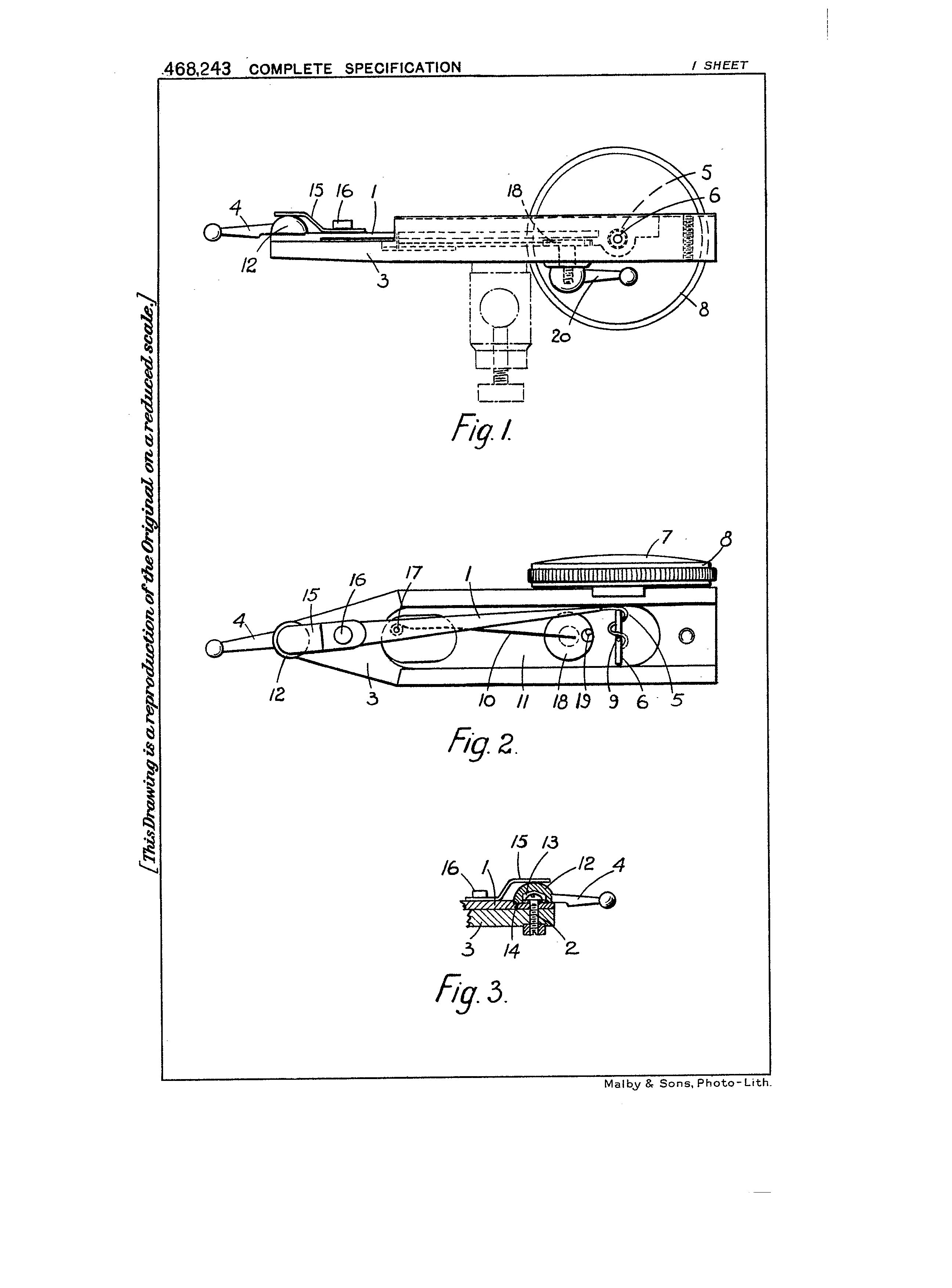
Referenced by GB 720,132 as the parent. Published one year before the firm's own founding date.
 Click to zoom
What it actually says
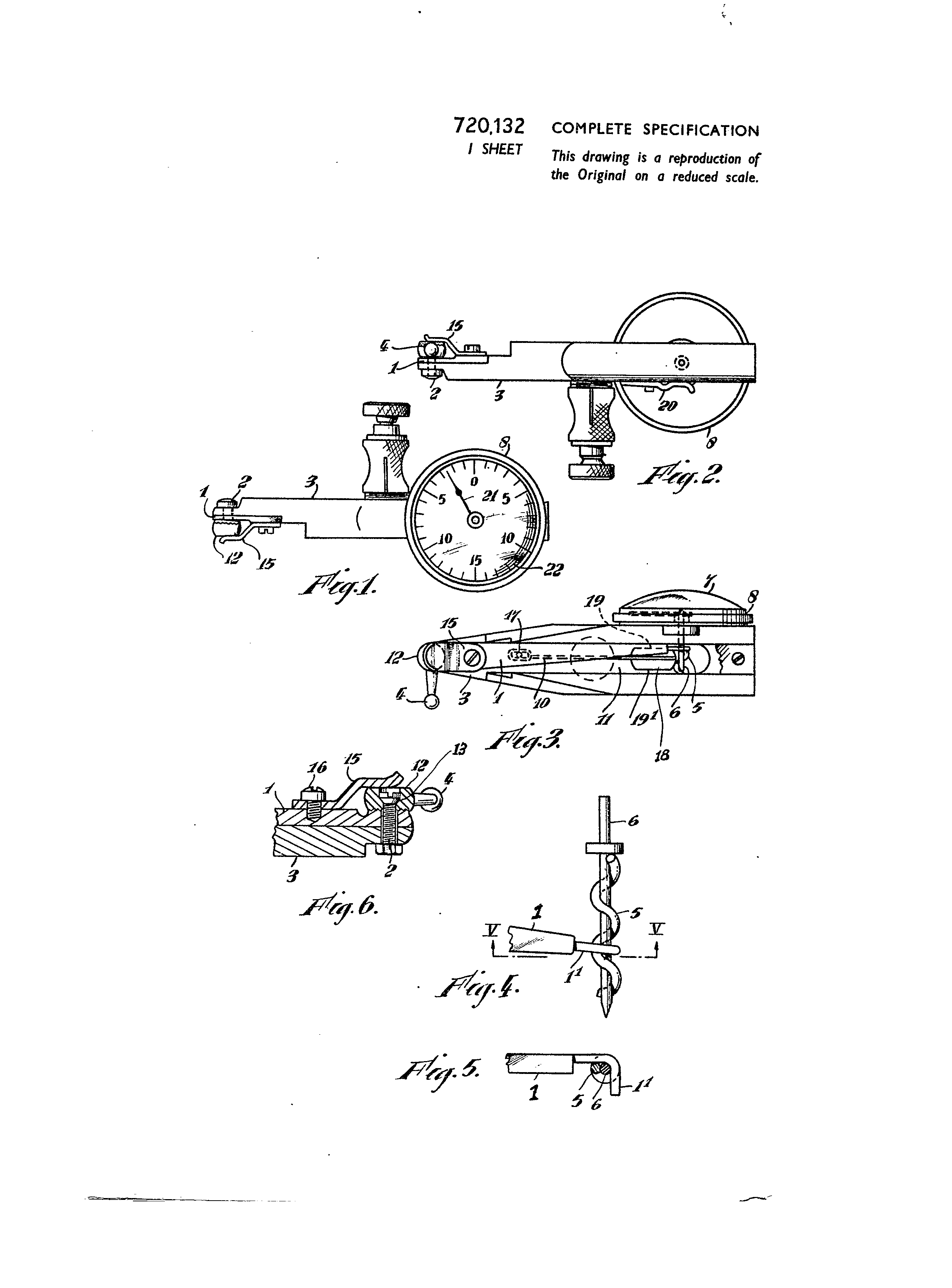
- A pivoted feeler transmits its deflections to a coaxially pivoted lever.
- The lever's free-end extension engages between adjacent turns of a helix fitted tightly on the shaft of the indicator needle.
- The helix may be of piano wire. permissive — not a requirement, and not evidence for any later unit
- Oscillating the lever rotates the helix, and with it the pointer shaft.
- A spring presses the lever up or down according to whether an upper or lower surface is being tested.
- A clip permits replacement or adjustment of the feeler, which is friction-held against the lever.
- Specification 468,243 is referred to.
 Click to zoom
The problem
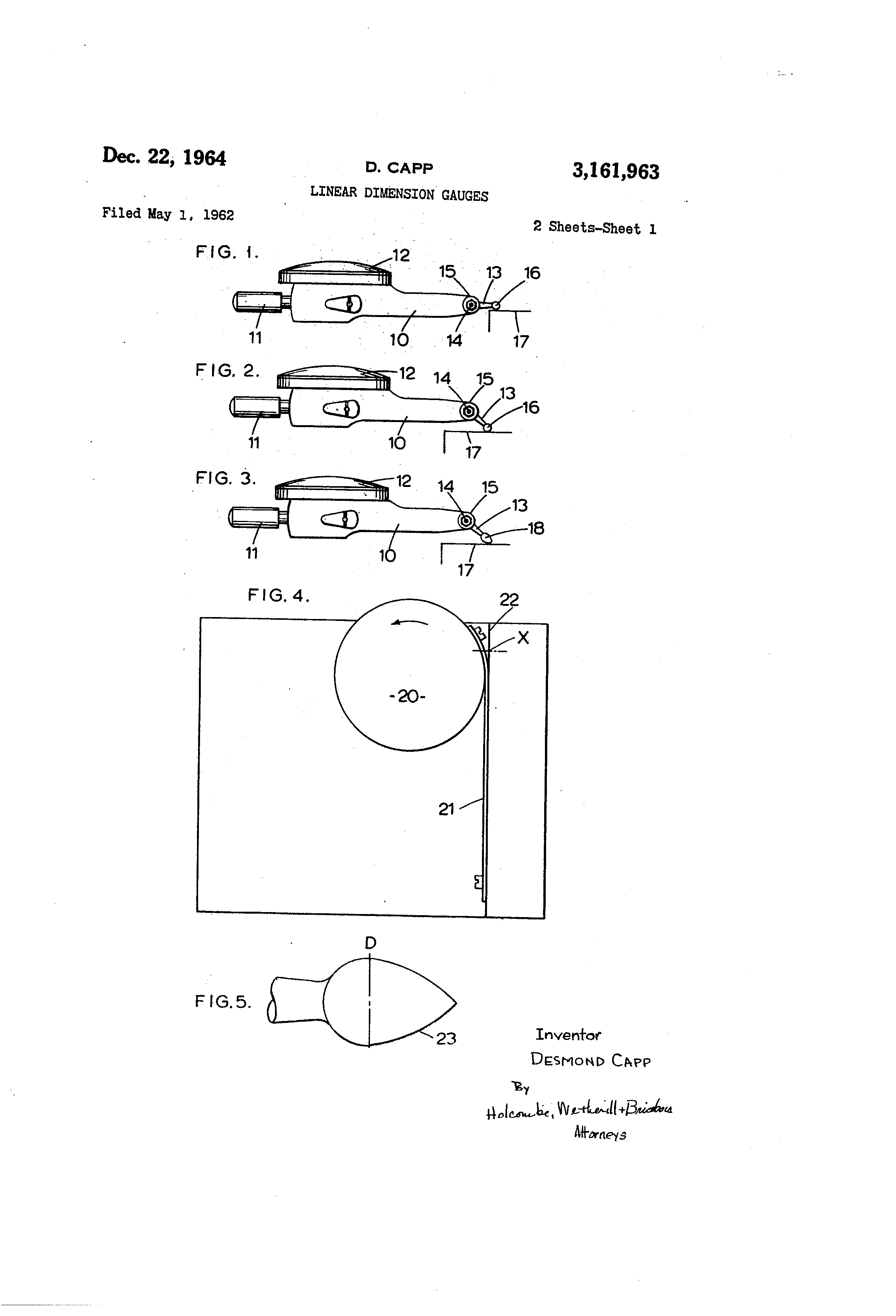
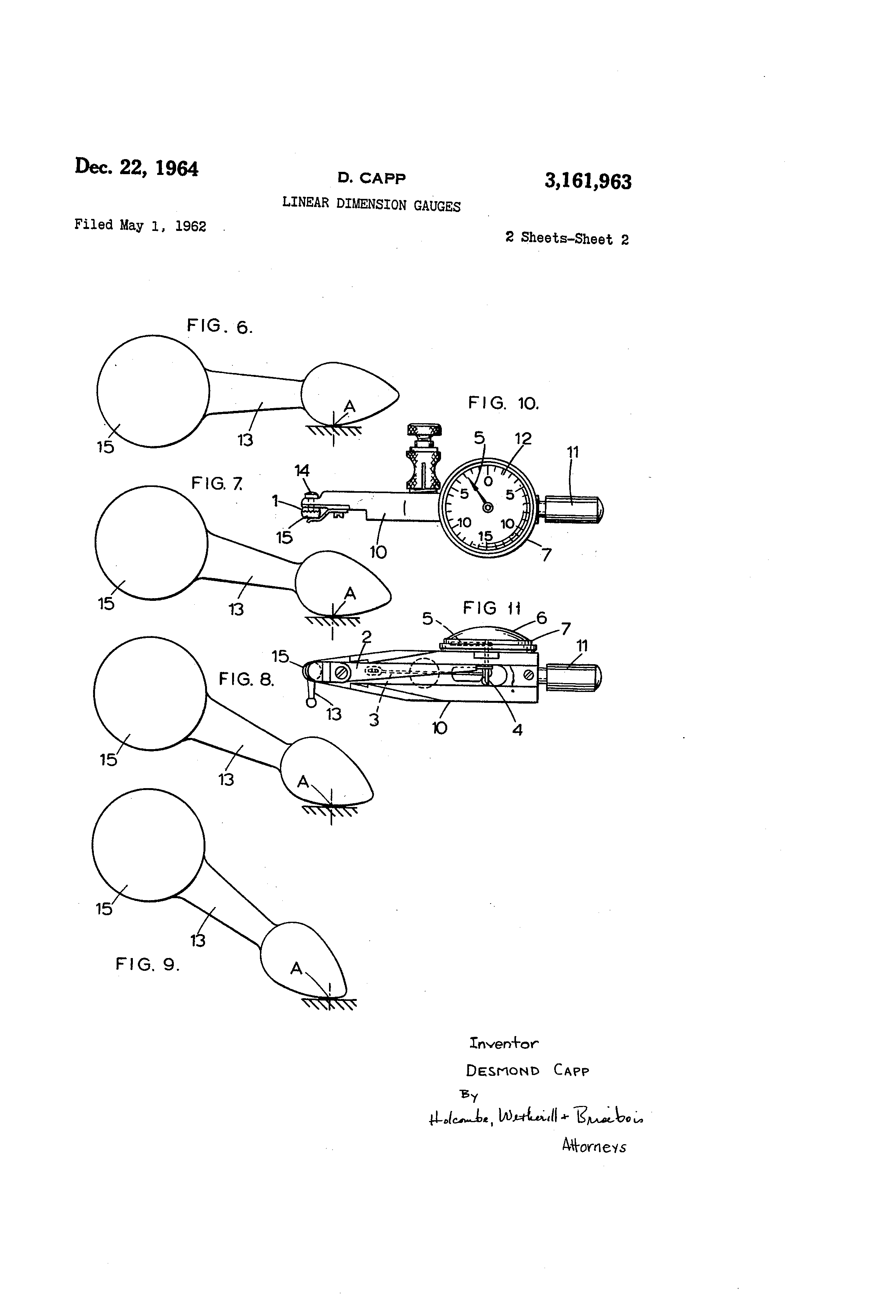
A lever indicator's stylus must tilt to clear the work. With a spherical tip, tilting shortens the distance between the working centres — the stylus pivot and the contact point — so the instrument reads wrong, and the error grows with tilt angle.
The fix
Taper the free end so the horizontal working-centre distance stays constant at every tilt. The profile is a roulette: the curve traced by a point on a disc rolled along a straight edge.
The patent closes by offering the ratchet connection "eliminated and replaced by a frictional connection" — the friction-clutch variant. That is the one Federal shipped.
 Click to zoom
 Click to zoom
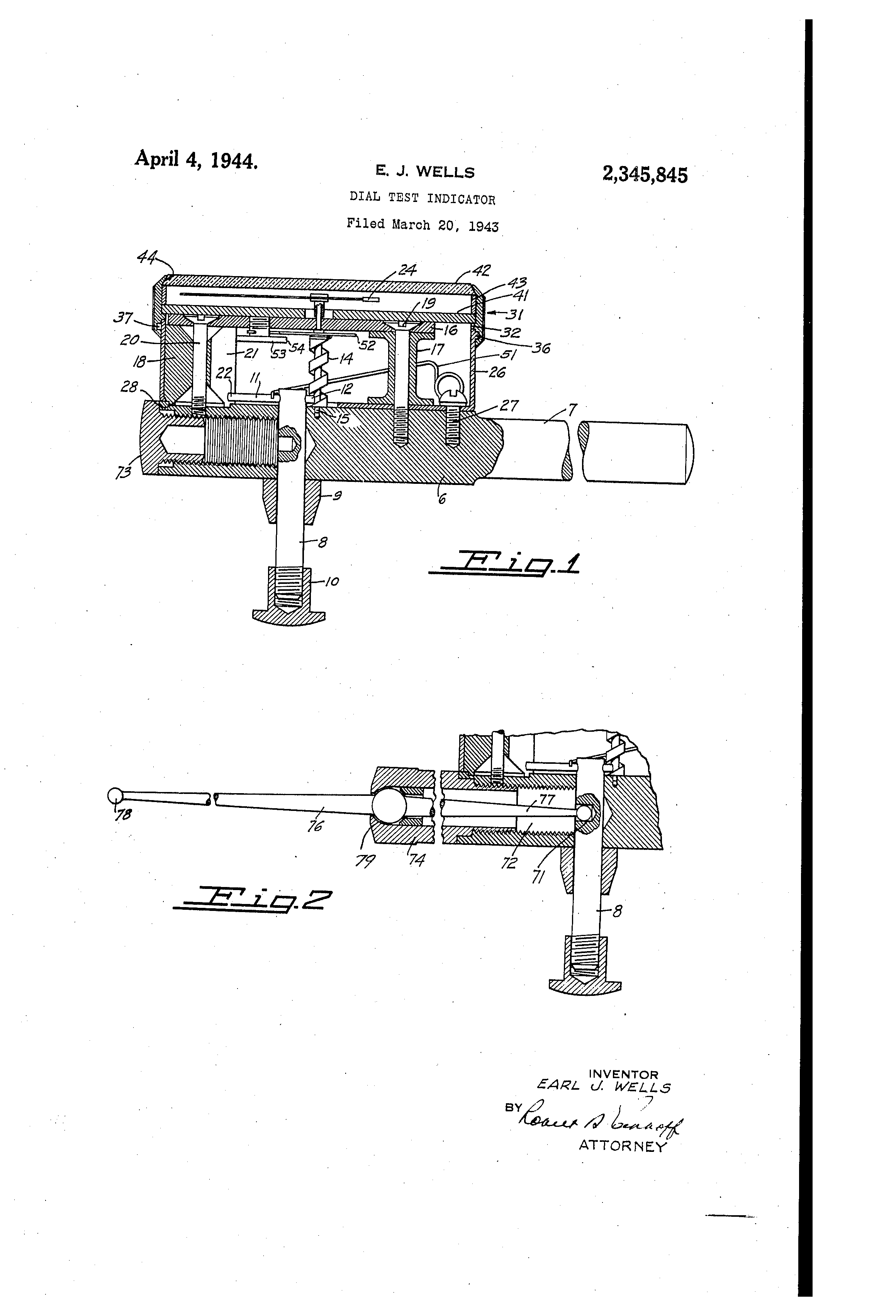
A plunger drives a pin engaging a worm on the pointer shaft; a hairspring is mounted directly on the worm shaft. Wells states outright that the design dispenses with gears and internal levers, and omits the troublesome internal gearing usual in such instruments.
 Click to zoom
A helix drive — and what we do not know about it
| Claim | Evidence | Status |
|---|---|---|
| Helix drive. A lever extension rides on a helix carried on the pointer shaft. No gear train. |
GB 720,132's topology. Verdict's own consistent description of a worm/helix mechanism across the whole range. Unidirectional hand travel on the collection's T-85. | |
| Wound from wire. | GB 720,132 says the helix may be of piano wire. That is a permissive clause in one 1952 specification. Nothing establishes the construction of any later unit. | 1952 only — unknown thereafter |
| Topology after 1954. Does the lever still drive the helix directly, or was a worm wheel introduced? |
None. No Capp patent has been found after the 1962 stylus family. Verdict's current copy still claims a "patented" lever and worm spiral, but publishes no number, and GB 720,132 lapsed decades ago — that is heritage language on an expired patent. | Untested |
The three states, and the one photograph that settles them
| Topology | Construction | |
|---|---|---|
| 1 | Lever pin rides between the turns of a helix on the pointer shaft | wound wire — GB 720,132 as filed |
| 2 | Same topology | cut / machined helix — a production change, invisible to the patent record |
| 3 | Worm meshing a worm wheel | a genuine redesign — a gear returns to the mechanism |
The third state is the one that matters. GB 720,132 has no wheel — the lever drives the screw directly. If a later Verdict has a worm wheel, Capp's anti-gear-train position was abandoned, and this dossier's thesis is dead rather than merely dated. If it is still pin-on-helix, the idea survived even if the wire did not — and "coil-type worm spiral" is honest heritage rather than a slogan.
What the wire would have meant — now a conjecture, not a finding
REV C argued that a wound helix explains how a small Crayford shop with no horological tradition competed with Geneva: wire and a mandrel instead of gear-cutting, with the amplification ratio set by the winding pitch. That argument now rests on a permissive clause in a single patent and cannot be stated as the maker's method.
What survives is weaker and honest: the 1952 specification permitted a wire helix, which suggests the design was conceived to be buildable without gear-cutting capability. Suggestive. Not established. conjecture
The fingerprint: the hand reads magnitude, not sense
A helix is a screw. The useful range is roughly one turn, biased to one end rather than centred, and the pointer sweeps the same direction whichever way the stylus deflects. Note precisely what this proves: a screw-type transfer. It does not prove a coil — a machined worm behaves identically. Starrett, Federal's own Street crown gear, Compac, Interapid and Käfer all reverse hand direction with stylus sense. A Capp instrument does not.
| Maker | Transfer mechanism | Hand behaviour |
|---|---|---|
| Lowe → Starrett | Friction lever → sector & pinion | Reverses with stylus sense |
| Federal (Street) | Conjugate crown gear → involute spur pinion | Reverses with stylus sense |
| Swiss (Compac / Interapid) | Jewelled sector & pinion | Reverses with stylus sense |
| Käfer / DIN 2270 | Gear train | Reverses with stylus sense |
| A. Capp & Son | Helix drive — no gear train | Unidirectional |
Spring bias is a feature, not a fault. GB 720,132 specifies a spring pressing the lever up or down for upper- or lower-surface work. The commonest complaint in British workshop reports — a Verdict that "doesn't return to zero" or "won't read both ways" — is an operator expecting Swiss behaviour from a 1952 design decision.
Fix the shape, don't correct the number
Set the stylus beside the helix and one design instinct appears, applied twice. Everyone else amplifies with gears; Capp changes the geometry of the transfer so he needs none. Everyone else accepts cosine error and corrects it procedurally; Capp reshapes the geometry of the contact so the error never arises.
Federal corroborates Capp — without ever naming him
The instruction sheet packed in the collection's Federal "80" Series Testmaster box is the strongest independent confirmation of Capp's stylus patent in existence. It was written by the customer.
| Federal's words | What it corroborates |
|---|---|
| "INVOLUTE TIP CONTACT POINT" |
Federal's name for the pear/tapered tip — and arguably the correct one. Capp generates the profile by rolling a disc along a straight edge and tracing a point; that construction produces an involute. Providence was already an involute house: Street's crown gear meshes an involute spur pinion. |
| compensates to ≈ 36° |
Federal instructs: the tip shape automatically compensates up to approximately 36°; apply no correction factor below 36°; do not use the involute tip above 36°. Capp's patent illustrates 0°, 12°, 24°, 36°. Federal's shop-floor sheet reprints Desmond Capp's patent limit exactly — and names neither Capp, nor Crayford, nor England anywhere on the page. |
| correction table .985 / .940 / .866 .766 / .643 / .500 |
For spherical tips only. Those are cos 10° / 20° / 30° / 40° / 50° / 60°, to three places. Federal states in print that spherical-tip error is the cosine — and that with the involute tip it vanishes. The geometric-versus-procedural split, published by the customer rather than the maker. |
| "clutch-mounted" contact point |
US 3,161,963 closes by offering the ratchet connection "eliminated and replaced by a frictional connection." The T-85 ships that alternative embodiment. |
Anatomy note. Capp says stylus; Federal says contact point. Verdict markets a pear; Federal specifies an involute tip. Same object, one workshop, four words — the exact comprehension gap REF-ANA exists to close.
How a maker's name disappears from its own instrument
Four instruments from one Crayford workshop, held in this collection. Read in order, they are a complete account of what happened to British precision manufacturing.
| Patent mark | The dial reads | Body | Who gets the credit |
|---|---|---|---|
| GB 468,243 | A. CAPP & SON LTD | — | The firm. Its own name, on its own instrument. |
| GB 468,243 | VERDICT | — | The works name. The brand has eaten the company. |
| GB 720,132 | FOWLER — VERDICT | — | Shared. The American distributor co-brands and advertises the English origin — its catalogue even describes the movement as auto-reverse, the helix, unrecognised. |
| none | TESTMASTER T-85 JEWELED · FEDERAL Made in England | bare | Nobody. Federal specified the dial — down to the American spelling of JEWELED, where Verdict writes jewelled — and paid for a casting with nothing on it. |
The only trace of Crayford left on that last instrument is four words of statutory origin marking and a T — Capp's own lever-series letter, surviving into Federal's 80-block as T-85 because nobody thought to renumber it away. Federal's house codes are B21, C81, D81S, E81. They never prefix with T.
Federal's own lever indicator is Street's US 2,141,627 (1938) — the conjugate crown gear, the most mathematically sophisticated document in this library, and a horizontal-dial instrument. By the 1970s the professional default was the slant dial, and Federal did not have one. Tooling a new movement is expensive. Buying one is not.
They had a precedent three miles away: Brown & Sharpe, also Providence, was already selling a Swiss-made instrument as the BesTest. American gauge houses buying lever DTIs from European specialists was normal — a lever DTI is a watchmaking product, and the American firms were tooled for plunger gauges and gauging systems.
Library consequence. Country of origin is now a mandatory census field on every Federal unit. "Federal" describes a brand, not a builder, and which is which depends on the decade and the product line. REF-PAT-FED requires REV D.
Why Capp wound a wire — the reason is not the one this dossier gave
Thomas Mercer Ltd of St Albans — marine chronometer makers from 1858, Maker to the Admiralty, Greenwich Trials competitors, producers of over thirty thousand chronometers — moved into dial indicators and gauges at their Eywood Road works, advertising "Dial Gauges of all Types" by 1947 and trading until 1984. They are a horological house, and their lever indicators are built like one.
So the real explanation is narrower, and better. It was not that Britain lacked watchmaking. It is that Capp did. A. Capp & Son came out of the Crayford armaments corridor, not Clerkenwell. The helix is what you invent when you need a precision motion multiplier and have no escapement shop behind you — and it is the more original instrument for exactly that reason.
| A. Capp & Son — Crayford | Thomas Mercer — St Albans | |
|---|---|---|
| Heritage | Thames-side armaments corridor, 1938 | Marine chronometers, 1858 |
| Transfer | Wound helix, possibly piano wire | Jewelled gear train |
| Hand travel | Unidirectional | Reverses with stylus sense (expected — verify) |
| Design logic | No horology → invent around it | All the horology → build it properly |
| US channel | Federal (white-label) · Fowler (co-brand) | Mueller Gages, San Gabriel CA |
No design exchange between Capp and Mercer is attested. The mechanisms differ in kind, and direct inspection of a Mercer unit shows no signature elements shared with Crayford. Recorded explicitly so that a future revision does not manufacture a relationship out of two English DTIs sharing a country. They are rivals, not relatives — and Verdict's standing claim to be "Britain's leading Dial Test Indicator manufacturer" was contested for decades by a firm with a Greenwich medal and 126 years of horology behind it. Mercer earns a separate dossier: REF-PAT-MRC, queued.
| Marking | Window | Status |
|---|---|---|
| A. CAPP & SON LTD on dial | earliest tier | Attested — the firm's own name. Primary document. |
| PAT. 468243 | 1937 → | Attested — founding patent, earliest marked generation. |
| PAT. 720132 | post-Dec 1954 | Attested — hard lower bound. Dates the Fowler. |
| Tapered stylus + ratchet detents | post-1962 | Strong, but corroborate — styli get swapped over sixty years. |
| Federal/Esterline case + "Made in England" dial | 1969–1999 | Attested — the white-label era. |
| Thames Road, Crayford | original works | Verified from the US 3,161,963 header. |
| Ashford (Cobbs Wood → Javelin House) | MJ Allen era | Verified — Companies House. |
| Budget / imported range | late, undated | Market tell. Buyers separate "vintage Verdict, made in England" from the later low-cost range — and the market sets your price whether or not the suspicion is fair. |
| # | Question | How it gets answered |
|---|---|---|
| Q1 ✔ | CLOSED. A. Capp & Son, Ltd., Crayford. Verdict Gauge Works, Thames Road. A. Capp, founder; Desmond Capp, son. | |
| Q2 ✔ | CLOSED. GB 468,243 · GB 720,132 · GB 930,287 / US 3,161,963 / CH 397,256 / DE 1,235,004. | |
| Q3 ★ | Does the tapered stylus hold working centres constant at 0.306″ through 0°/12°/24°/36°? | Bench test. Grade 0 blocks, ratchet sweep, deviation plot, spherical control. Falsifiable, with a number. Unpublished anywhere. |
| Q9 ★ | Read GB 468,243 in full. Is the helix already in the 1937 patent, or did GB 720,132 replace an earlier idea? | Espacenet full text. This dossier deliberately does not assume. |
| Q10 ★ | What happened to A. Capp & Son, Ltd.? Dissolution; how the Verdict name reached Rother Machine Tools by 1978. | Companies House dissolved-company search on Capp; Grace's Guide under Capp; Kelly's Directory of Kent. |
| Q7 | Start/end dates of the Federal OEM arrangement; which Federal model codes are affected. | Federal census, country of origin mandatory. Esterline-era catalogues. |
| Q8 | Why Kent and not Geneva? | Esterline-era trade press; Federal catalogue copy — was the helix marketed, or hidden? |
| Q11 | Reverse of the Federal instruction sheet — "Are you using the correct contact point?" | Photograph it. May name the involute tip's Federal part number. |
| Q13 ★ | Open the T-85. Wound wire, cut screw, or worm-and-wheel? Settles whether the helix construction survived, whether "coil-type worm spiral" is description or slogan, and whether the anti-gear-train position was ever abandoned. | Bezel, crystal and dial off. One photograph of the movement plate. The single highest-value action available. |
| Q12 | Confirm Mercer's hand-travel behaviour (expected: reverses — a gear train). | One deflection. First datum for REF-PAT-MRC. |
| Q4 | Were Verdict plunger gauges ever in-house? (Käfer 23/xxxx rebadges confirmed.) | Bezel inspection of a pre-1978 Verdict-branded plunger gauge. |
| Q6 | Is "Rapid" — the inclined-dial line — related to InteRapid? Two coincidences: the name root and the defining feature. | Catalogue archaeology. Default assumption: no. |
- Collection holdings (primary — this dossier rests on them). Dial marked A. CAPP & SON LTD. Two Verdict-brand units marked PAT. 468243. One Fowler Verdict marked PAT. 720132. One Federal TESTMASTER T-85 JEWELED, 0.001″, slant dial, Made in England, no body markings, no patent number, Federal/Esterline case — unidirectional hand travel confirmed by hand; bezel diamond jimping, hand-and-hub, casting and screws compared directly against a Verdict T31. Federal "80" Series instruction sheet from the same box.
- US 3,161,963 — Desmond Capp, Verdict Gauge Works, Thames Road, Crayford; assignor of one-half to A. Capp & Son Limited. Full specification read.
- GB 720,132 — A. Capp & Son, Ltd. and A. Capp. Helix on the pointer shaft; lever extension between adjacent turns; helix may be of piano wire; spring bias; clip-replaceable feeler. Refers to specification 468,243.
- GB 468,243 — published 1 July 1937. Full text not yet read (Q9).
- US 2,345,845 — Wells, 1943/44. Convergent, not ancestral. Context only.
- Companies House / OpenCorporates — VERDICT GAUGE LIMITED 01363601, incorporated 18 Apr 1978, previously ROTHER MACHINE TOOLS LIMITED; MJ Allen Group, Ashford.
- Federal corporate history — Providence 1918; Esterline 1969; Carl Mahr Holding merger 1999 (FTC early-termination record, 26 Oct 1999).
- Fowler catalogue and market listings — Fowler Verdict 52-555-005, 52-555-010, 52-560-005, 52-560-040; "Fowler Verdict T5"; Made in England; full jewelled movement; auto-reverse. Standalone Verdict models "C" and "T3" attested.
- verdictgauge.com — T31 Imperial (01/3031): inclined dial, Rapid range, precision worm mechanism, dovetails top and bottom, rear swivel spigot. "Coil-type worm spiral." Pear-stylus cosine claim.
- Thomas Mercer Ltd — Grace's Guide; St Albans Museums. Chronometers 1858–1984; Eywood Road gauge works; "Dial Gauges of all Types," British Industries Fair 1947.
- Mueller Gages Co. — San Gabriel, California; Kurt H. Mueller; first product 1949; gage-fixture house buying in indicators.
- Model Engineer & Workshop forums — pear-stylus error reduction independently reported as measurable; plastic reversing-lever failure and field repair; chamfered friction washer; one-turn biased travel misread as a fault.
- Grace's Guide — no Verdict entry. Now explained: the firm was never called Verdict. Search under Capp.
- Not found: any published account, anywhere, of the Capp–Federal OEM relationship. This dossier is the only one.
| Rev | Date | Changes |
|---|---|---|
| A | 2026-07-11 | Initial. Movement identified as non-gear-train. Corporate entity gap found (01363601, 1978, ex-Rother Machine Tools). Käfer plunger rebadge established. Wells logged convergent. Pear stylus logged unmeasured. Proposed the "Whitworth thesis" — later falsified. |
| B | 2026-07-11 | Federal OEM relationship confirmed from collection specimen. Rapid/slant-dial range documented. Q1 re-specified after the Grace's Guide silence. Country of origin made a mandatory Federal census field. First parts[] block — seeds REF-ANA. Two REV A inferences corrected: the slant dial does not indicate Swiss origin; the "real Federal" prior falsified. |
| C | 2026-07-11 | MAKER IDENTIFIED — A. Capp & Son, Ltd., Crayford; Verdict Gauge Works, Thames Road; A. Capp and Desmond Capp. PATENT TRAIL CLOSED. Both recovered from patent numbers stamped on collection units. Mechanism corrected: a helix drive, not a gear train. Whitworth thesis falsified. Stylus geometry documented; Q3 made falsifiable. Crayford armaments-corridor hypothesis confirmed. Badge-recession sequence established. |
| D | 2026-07-11 | Federal instruction sheet recovered from the collection box — independent corroboration: the involute tip contact point, Capp's 36° patent limit reprinted as a shop-floor instruction, and a spherical correction table that is the cosine to three places, supplying Q3's control curve. Clutch mount identified as the patent's frictional embodiment. British schism established: Thomas Mercer (St Albans chronometer house) falsifies the "Britain lacked watchmaking" premise — corrected to "Capp lacked it, not Britain." Mueller Gages ruled out as a Capp channel; their English DTIs are Mercer. No Capp–Mercer design exchange attested (negative finding, recorded). REF-PAT-MRC queued. Anatomy drawings and external references added to parts[]. Rebuilt against the house stylesheet. |
| E | 2026-07-11 | CLAIM DEMOTED — the "wound" helix. REV C asserted a wire-wound helix as the maker's method and built its central argument on it. GB 720,132 says only that the helix may be of piano wire — a permissive clause in one 1952 specification. Nothing establishes the construction of any later unit, and no Capp patent has been found after 1962. A switch from wound to machined would need no patent and leave no trace. Claims now split: helix drive = established; wound construction = 1952 only; post-1954 topology = untested. The fingerprint statement tightened — unidirectional hand travel proves a screw-type transfer, not a coil. The manufacturing thesis demoted from finding to conjecture. Q13 opened: photograph the movement plate. Rebuilt against the shared house stylesheet. |