 Instrument
Reference Library
Federal Products — Providence
C. C. Street & the Miracle Movement
Providence: the design-house gauge maker
Federal Products Corporation of Providence, Rhode Island grew up in Brown & Sharpe's hometown and became the other serious American indicator house — arguably the most design-conscious of them. Chauncey C. Street was Federal's house inventor; his 1937 filing shows the firm's engineering temperament exactly: rather than accept the compromises every other maker lived with, Federal invented a new gear tooth. The corporate line runs forward to Mahr Federal — making the Puppitast on this bench a distant corporate cousin of the 1938 patent.
Street's verified patent — the trail is open
One Street/Federal patent is verified below. Street was a serial inventor and Federal's portfolio is certainly larger — including whatever covers the Miracle Movement. Count stated as known, not exhaustive; the trail continues in the next research session and against patent numbers found stamped on collection units.
The problem it solves
- A lever test indicator wants the dial facing the operator while the stylus swings in a perpendicular plane — motion must turn a corner. At watch scale, Street states flatly, commercial bevel gears are only approximations and spiral gears are accurate only at impractical cost, with friction that forbids high magnification.
What Street invented
- A crown gear whose teeth are the mathematical conjugate of an involute spur pinion: tooth flank pressure angle calculated incrementally at every radius (the formulas are in the patent), so inner and outer ends of each radial tooth — which travel at different speeds — both transmit velocity exactly. Flanks come out subtly concave; teeth taper wider at the gear's inner edge.
- Continuity ≥ 1 (1.4 found satisfactory): some tooth pair is always in contact — no hand-off backlash, contact walking across the flank as a travelling line.
- Manufacturing method included: the cutter is shaped as the pinion and both rotate in mesh during cutting — the gear is literally formed by its own mate's motion. Street's vivid description: visualize soft teeth shaped by the impression of the turning pinion.
- The indicator embodiment is a complete DTI architecture: two-part stylus lever held by friction spring (angle adjustment), spring-bias reversal selected by an external handle (a reversing lever), gear segment → pinion → crown-gear segment → dial-staff pinion, with the dial movement as a self-contained unit.
Documents
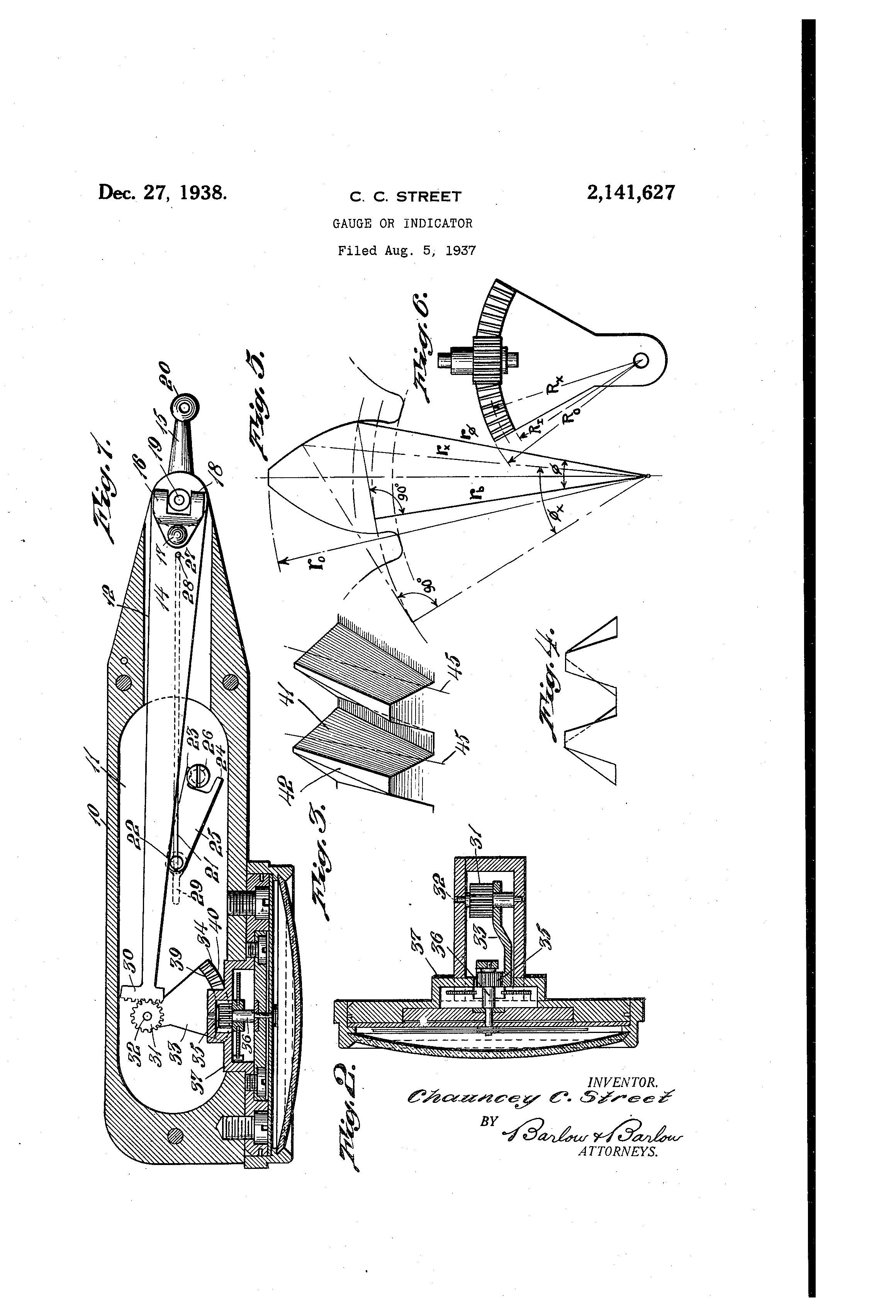 Click to zoom
What is attested, what is open
Attested: "Miracle Movement" is Federal's branded movement for the plunger dial indicator line (models across A/B/C/D/E and metric O prefixes), marked on the dial face and typically paired with "FULL JEWELED." Field reputation records an exceptionally good, nearly shock-proof movement — the marketing name earned its keep. A known service weakness is also on record: a soft-steel component that deforms and produces stickiness (per Long Island Indicator, referenced in forum discussion) — a repair-bench detail to verify at teardown.
Open — the core questions this dossier exists to close: the patent number(s) covering the movement; the introduction date of the branding; the exact mechanism that justified the name (shock-protection architecture, gear-train arrangement, jeweling scheme); and whether Street or another Federal engineer designed it. Relationship to US 2,141,627: sibling product lines, not sequential designs — 2,141,627 is the test-indicator (lever) patent; the Miracle Movement brands the plunger line. Whether the branding pre- or post-dates 1938 is unestablished; any Miracle-marked unit with visible patent numbers in this collection resolves it instantly.
Primary documentation plan (collection-driven): (1) census all Federal units — model code, every marking, patent numbers verbatim, dial style incl. green-background early tell, "Model #One"-era unbranded features; (2) transcribe patent numbers from Miracle-marked units → pull those patents; (3) one teardown of a duplicate Miracle Movement unit, photographed and filmed to bench standard — likely the first published look inside; (4) test the "72-12"-style trailing code = date code hypothesis against the census. The collection is the archive; the record barely exists elsewhere.
Collection-held factory documents
| Document | Date | What it establishes |
|---|---|---|
| Form A-712 — Testmaster Series 80 contact point instruction sheet (original held) | © 1980 | Federal's street address: 1144 Eddy Street, Providence RI 02901 (the Eddy St. plant — address + ZIP date-consistent with the 1980 copyright). Full Series 80 model decode: T = 1⅜"/35mm dial, LT = 2"/51mm dial; -82…-86 inch line, -87…-89 metric line; three contact-point length tiers per system. PT-500…PT-521 part-number block for points. Service rule set: lengths never interchangeable across tiers; metric points are blackened and differ slightly in length from inch (.541/.514, .811/.799, 1.622/1.598) — a blackened loose point is metric by definition, and a mismatched point fits but mis-measures. Digitized in full: federal-testmaster-contact-points.json. |
The Testmaster Series 80 sheet also refines the model map: the Testmaster (lever DTI) line and the Miracle Movement (plunger) line carry separate numbering systems — T/LT-8x vs the letter-digit plunger codes (B21, C81…). Any Series 80 units in the collection census should be checked against this sheet's part numbers for point correctness — a cheap authenticity/completeness check the market never performs.
The dial color — official name, no official number
Attested: Mahr's catalog designation is "soft-green tint" (inch dials); retailers carry it as Face Color: Soft Green. The tint is functional twice over — catalog copy states soft-tinted dials minimize eye strain, and the color encodes the measurement system: green = inch, soft-yellow = metric ("light green to be easy on the eyes and inch recognition," per current product copy). Same house instinct as the blackened metric Series 80 contact points (form A-712): Federal/Mahr color-codes inch vs. metric across faces and parts. The green is a continuous house signature from the early light-green ("uranium"-style) Miracle Movement-era dials through today's MarCators — surviving the Mahr merger intact.
No standard designation exists in any published record — no Pantone, RAL, FS 595, or paint-system number has ever been issued or measured publicly. The color has a name but no numbers.
Cross-system estimates — UNMEASURED, starting candidates only
| System | Nearest candidates | Caveat |
|---|---|---|
| RAL Classic | 6019 Pastellgrün (nearest); dial reads paler/grayer than the chip | Estimates from familiarity, not instrument measurement. Modern dial is a pale, desaturated, slightly cool green — whiter than most standard-deck greens. True match likely falls between chips; report nearest + ΔE when measured. |
| Pantone | pale green-tint families ~5595 C / 621 C / 5807 C | |
| Hex (sRGB) | ~#D4E2D0 – #DEE9D6 (clean modern dial) | |
| FS 595 | no close pale green; common deck greens run more saturated |
Eras are distinct targets: vintage "uranium" green is yellower and slightly deeper than modern soft green, and surviving examples carry decades of aging/UV drift from as-printed — treat "Federal green" as at least two colors (possibly three) across production eras.
Measurement protocol (pending — collection rig is sufficient): dial shot straight-on under the studio panels with a gray card/white-balance target in frame; custom WB off the card; sample an unshadowed patch of the dial field clear of printing; average RGB → nearest-chip conversion per system with ΔE reported. One modern MarCator + one sample per vintage era in the census, same session and lighting = the first published numeric characterization of Federal green. Results land here as a REV increment: era / sample unit / measured sRGB / nearest RAL / nearest Pantone / ΔE.
This makes the measurement more valuable, not less: if the same green appears on an in-house plunger gauge, a Crayford lever DTI and a Swiss LT-150, then a calibrated reading becomes a cross-supplier dating instrument — one number bracketing units from three countries onto a single Federal timeline. measurement still pending
Federal stopped building its own lever indicators
Street's US 2,141,627 is a horizontal-dial instrument, and it is the finest piece of engineering in this library. By the 1970s the professional default had become the slant dial — the format Interapid made standard — and Federal did not have one. They did not tool a new movement. They bought lever indicators from outside makers and printed FEDERAL on the dial. Not from one supplier. From several.
This is not speculative. It is attested by instruments in the collection and by dials in the market. Brown & Sharpe — three miles away in the same city — had already done exactly this, selling a Swiss-made instrument as the BesTest. A lever DTI is a watchmaking product; the American houses were tooled for plunger gauges and gauging systems. Buying the lever line in was the normal answer, and Federal took it.
| Testmaster | Origin on dial | Builder | Basis |
|---|---|---|---|
| Street's original | Providence | Federal, in-house conjugate crown gear, horizontal dial |
US 2,141,627 |
| T-85 · .001″ slant dial |
MADE IN ENGLAND | A. Capp & Son, Ltd. Crayford, Kent — helix drive |
Collection specimen. Unidirectional hand travel; T-prefix is Capp's own lever-series letter; diamond bezel jimping; hand-and-hub; Federal/Esterline case. — see REF-PAT-VDT |
| LT-150 · .00005″ | SWISS MADE | Swiss — which firm is open (Compac / Corvus / TESA-group) |
Dial marking. supplier unresolved |
| others | ? | ? | ongoing — the collection does not yet hold the full set. This section will not close for some time. |
Federal specified the dial, whoever built the movement
The clearest evidence that these are contract manufactures to Federal's spec, not rebadged catalogue units, is the dial artwork itself — it is uniform across suppliers who would never have printed it that way themselves:
- "JEWELED" / "FULL JEWELED" — American spelling, on an English-built instrument whose maker writes jewelled, and on a Swiss-built one.
- The green/yellow dial coding — Federal's inch/metric system, applied to a Swiss movement (see 03c).
- Renumbering into Federal's own blocks — the Crayford unit became a T-85 in the 80-series.
- An unmarked body. The T-85 carries no maker's mark, no patent number, nothing. Federal paid for a casting with nothing on it. The residue of Crayford is four words of statutory origin marking and a stray T.
How to identify who built your Federal Testmaster
Non-destructive, ordered by decisiveness. This is the deliverable — the fact is a moving target, the method is not.
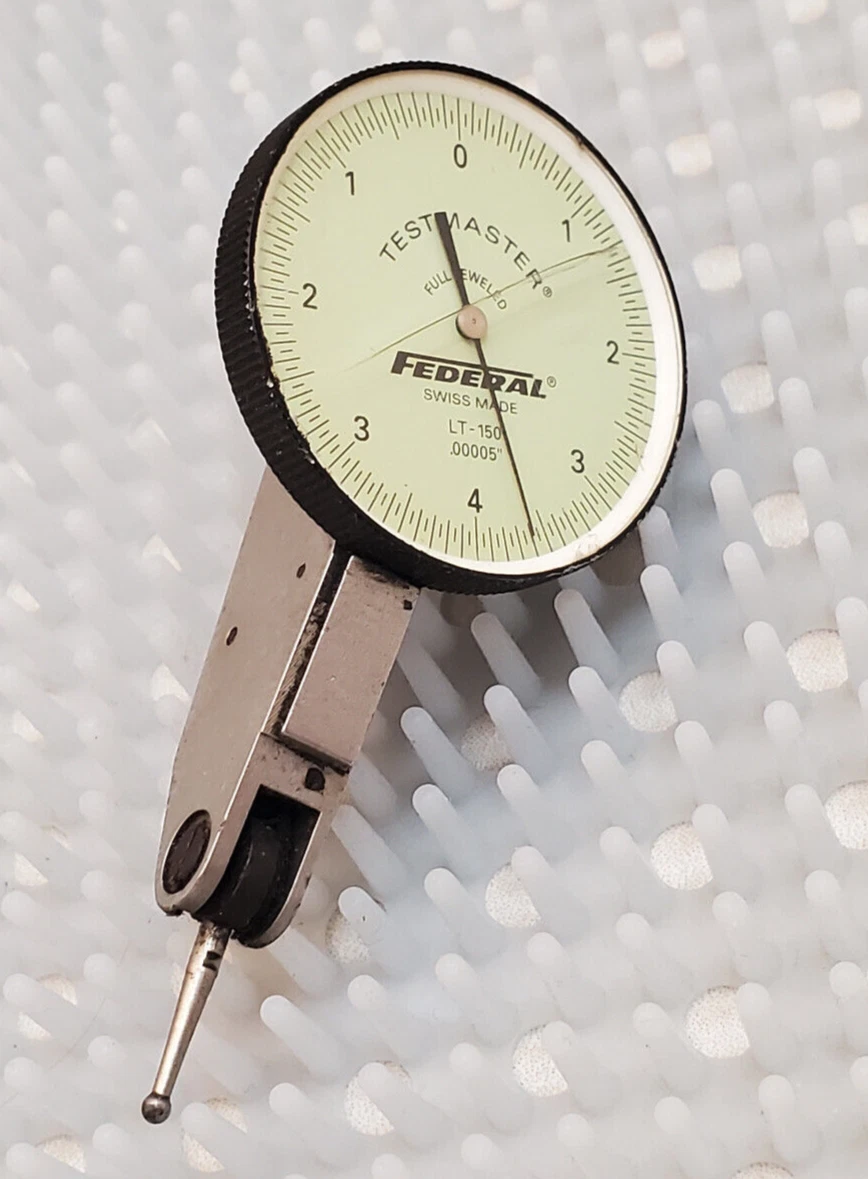
What the specimen shows
| Observed | Reading |
|---|---|
| SWISS MADE, under FEDERAL | Federal never manufactured outside Providence. Built abroad, badged in Rhode Island. |
| "FULL JEWELED" American spelling | Federal specified the dial artwork for a Swiss-built movement — the same tell as on the Crayford T-85. Contract manufacture to customer spec, not a rebadged catalogue unit. |
| Green dial · .00005″ (inch) | Federal's inch/metric colour coding applied to a Swiss movement. Dial colour attributes nothing about the builder — see 03c. |
| Straight bezel jimping | Not Capp. Diamond jimping is a Crayford trait and it survives onto Capp-built OEM units. Straight knurling here is a clean negative — and it means the jimping test in the decision tree works. |
| Spherical contact point | Not an involute tip. Consistent with a non-Capp supplier — though styli get swapped, so corroborating rather than decisive. |
| Bare body, no patent number | Same white-label signature as the T-85. Whoever built it, Federal paid for a casting with nothing on it. |
| Slant dial, flat slab body, barrel stylus clamp | The form factor is the identification lead. supplier unresolved — Compac, Corvus and TESA ended up under common ownership, so "Swiss Made" may not resolve to a single firm the way "Made in England" resolved to Crayford. Do not guess. |
Form A-712 (1980, 1144 Eddy Street) and the instruction sheet from the collection's Testmaster box document a contact point Federal calls the INVOLUTE TIP CONTACT POINT.
| Federal's instruction | What it corroborates |
|---|---|
| Correction factors .985 · .940 · .866 .766 · .643 · .500 spherical tips only |
Those are cos 10° / 20° / 30° / 40° / 50° / 60°, to three places. Federal states in print that spherical-tip error is the cosine of the lever angle. Standing advice: avoid setups above 30°. |
| Involute tip: compensates to ≈36°; apply no correction below 36°; do not use above 36° |
Capp's US 3,161,963 illustrates the stylus at 0°, 12°, 24°, 36°. Federal's shop-floor sheet reprints the patent limit exactly — and names neither Capp, nor Crayford, nor England anywhere on the page. The tapered profile holds the working-centre distance constant at 0.306″ through every tilt, so no correction is needed. The white-label runs all the way down to the paperwork. |
| "clutch-mounted" contact point |
US 3,161,963 closes by offering its 12° ratchet "eliminated and replaced by a frictional connection." Federal shipped that alternative embodiment. |
Terminology. Capp says stylus; Federal says contact point. Verdict markets a pear; Federal specifies an involute tip. Same object, one workshop in Kent, four words. Federal's is arguably the correct one — Capp generates the profile by rolling a disc along a straight edge, which traces an involute, and Providence was already an involute house via Street's spur pinion. Carried into REF-ANA.
Source register
- USPTO full text via Google Patents: US 2,141,627 (Street/Federal Products, Providence RI; filed 1937-08-05, granted 1938-12-27; complete specification including pressure-angle derivation and claims 1–10).
- Google Patents citation index — cited by National Broach & Machine 1949, GM 1966 & 1975, later gearing filings.
- Hobby-Machinist forum — unbranded "Model #One" unit marked with the patent; 1938 identification.
- Practical Machinist — Miracle Movement shock-proof reputation; Long Island Indicator soft-steel stickiness reference; Mahr Federal service lineage.
- Market listings (multiple) — Miracle Movement marking conventions across model codes A21/B21/B81/C71/C81Q/D81S/E81/O61 etc., FULL JEWELED pairing, Providence marking, green-dial early examples, "72-12"-style trailing codes.
- Collection holdings — multiple units marked 2,141,627 (census pending); substantial Federal section (founding brand of the collection).
- Collection ephemera — Federal form A-712 (© 1980), Testmaster Series 80 contact point sheet: Eddy Street address, model/part decode; digitized as federal-testmaster-contact-points.json.
- Mahr Federal current datasheets and retailer listings — "soft-green tint" designation, Face Color: Soft Green, green=inch / yellow=metric coding, eye-strain rationale.
| Rev | Date | Changes |
|---|---|---|
| C | 2026-07-08 | Street US 2,141,627 verified. Miracle Movement documentation frame. Ephemera register (form A-712). Federal Green: soft-green tint, inch/metric colour coding, measurement protocol specified. |
| D | 2026-07-11 | THE TESTMASTER IS A BADGE. Federal's slant-dial lever line was built by outside makers. T-85 confirmed as A. Capp & Son, Crayford, Kent (collection specimen: Made in England, unidirectional hand travel, T-prefix, diamond jimping, bare body, Esterline case) — see REF-PAT-VDT. LT-150 confirmed SWISS MADE, supplier unresolved. Country of origin made a mandatory census field. Maker-attribution decision tree published. Federal's involute tip contact point identified as Desmond Capp's US 3,161,963 geometry, with the 36° limit and the cosine correction table reprinted from Federal's own instruction sheet. Federal Green shown to travel across suppliers — dial colour cannot attribute a builder. Model-prefix-as-supplier-code hypothesis raised and rejected against this dossier's own T-8x/LT-8x parallel numbering. parts[] block added, seeding REF-ANA. Rebuilt against the shared house stylesheet. |
Related documents
Links resolve within the reference/ tree (dossiers/<family>/ layout). Cross-references also carried in the JSON sidecar as relatedDocs.