 Instrument
Reference Library
Vintage Alina / Compac
The pre-IXL K & M series
Opening frame. Alina was the United States market name for the lever-type dial test indicators of Compac of Geneva, Switzerland, sold in the American trade from roughly the 1950s until the mid-1960s, when the K and M model series were discontinued in favor of the IXL line. The brand is dead, its maker long since absorbed into the modern TESA group, and its documentation has proven elusive: as of this writing, no factory catalog, parts chart, or model specification for the K or M series has been located in online or published sources — searches documented in §7. Whether such records survive in private collections, TESA's archives, or undigitized trade literature is unknown, and locating them is itself one of this file's open threads (Q10). What is currently available amounts to the instruments themselves, a handful of new-old-stock parts in distributor inventories, one period Lufkin catalog covering the same instruments under their later brand, one repair shop's institutional memory, and scattered owner anecdotes.
Goal. This file assembles a measured specification record of the pre-IXL Alina line: a model census, the contact point system, the production period, and a verification of the trait that motivated the project — these indicators appear to carry unusually long measuring range for their era and class.
What to expect. The census (§4) grows one card at a time as specimens and period sources surface; stub cards mark models known to exist but not yet characterized. The range investigation (§5) is the headline thread the rest of the file supports. Open questions are numbered (§8). A cold reader should start with the historical recap (§1); a returning reader goes straight to the census and the Q-list.
Status. Living document. Rev A. Specimens held: four on the bench (M31 CPX-002, Lufkin V32X CPX-003, and two further units to be enumerated at the photo session), one inbound (K25 CPX-001). Questions: 16 open, 0 closed — with the Lufkin decoder (Q9a) closed by the period catalog.
Origins. The instruments sold in America as Alina were made by Compac of Geneva, Switzerland — Compac Fabrique d'Appareils de Mesure — one of the Genevan lever-indicator houses. In Europe the same instruments were sold under the brand name Parvus; Alina was the American market identity. Likely Long Island Indicator, corroborated by period listings showing “Compac Genève” with brand names together on dials.
The Alina identity. “Alina” was the brand under which these indicators reached the US market, roughly through the 1950s and into the mid-1960s. Who held the name — a factory export brand or an American importer's mark — has not been established, and the answer likely dates the brand's entry (§3). Per Long Island Indicator, these were the best-selling indicator and dial bore gage imports in the United States in the 1950–60s. Provisional on the brand mechanics; the US-market facts are Likely per Long Island Indicator.
The product family. The known lever-DTI range comprises the K series and M series. Period NOS parts listings show the two series took different contact points (§6), and surviving model numbers carry h/v suffixes read provisionally as horizontal/vertical dial orientation (Q7). What the series letters and digits encode is under active test (Q6, Q9b — see §5 decoder). Owner reports and the founding specimens suggest the family's distinguishing traits were measuring range and dial magnification beyond contemporary norms — the claim this file exists to test (§5).
Succession. In the mid-1960s the K and M series were discontinued and succeeded by the IXL line; Compac subsequently redesigned its indicators into the form documented in the modern parts literature, and the firm was ultimately absorbed into the TESA group, where the lineage survives today as the Compac / P-Line family. Likely on the discontinuation/IXL step (Long Island Indicator); the TESA absorption is Established, multi-source (REF-STY genealogy). The practical consequence: modern Compac parts data does not apply backward to K/M instruments, and this file is the designated home for the pre-IXL record. The model line also crossed brand marks: the census holds an externally identical pair of the same instrument under Alina (“M31”) and Lufkin (“V32X”) branding — see the §4 mapping table. The external identity is Established (both on the bench); the internal identity is Provisional pending comparative teardown (Q11/Q13).
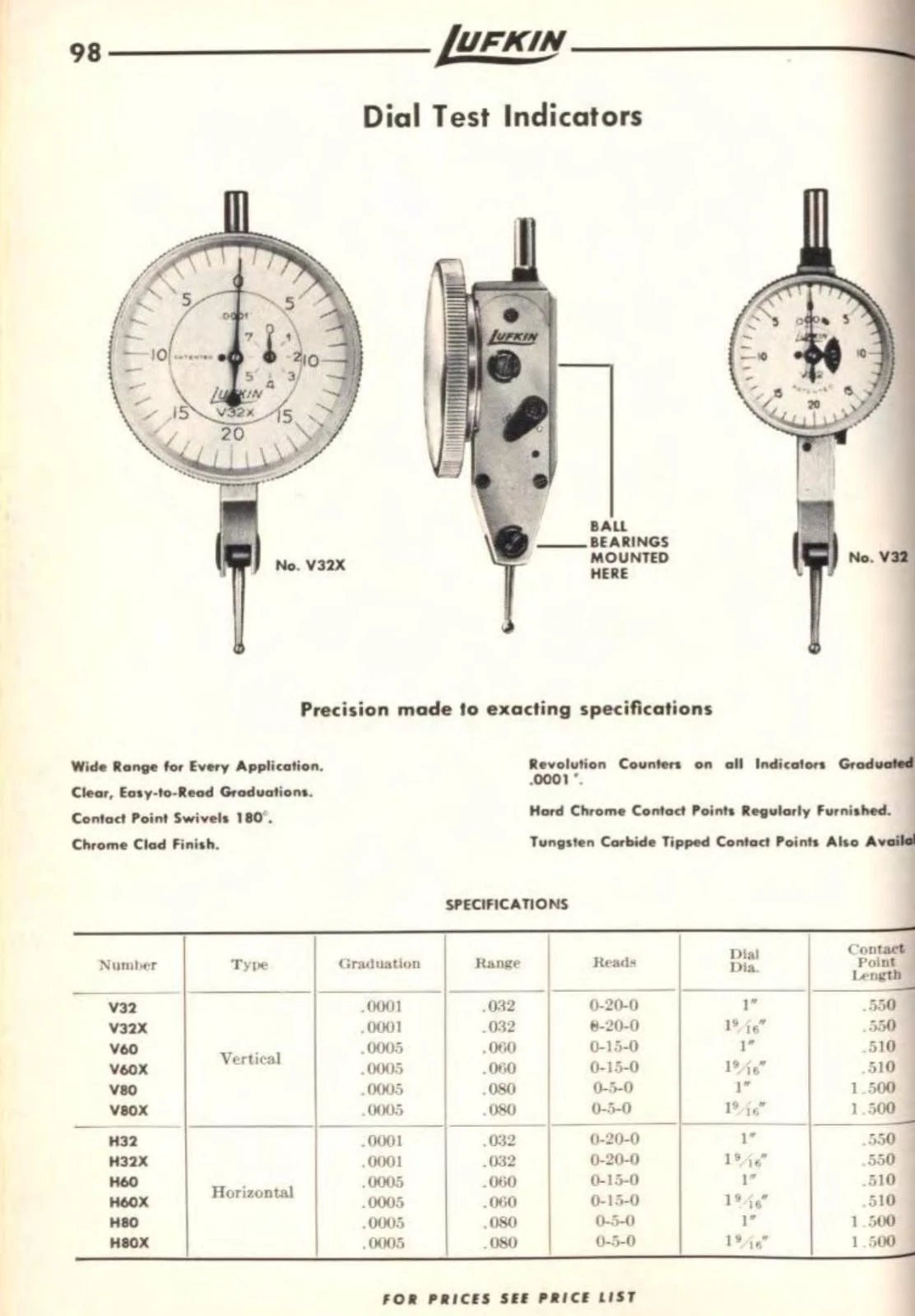
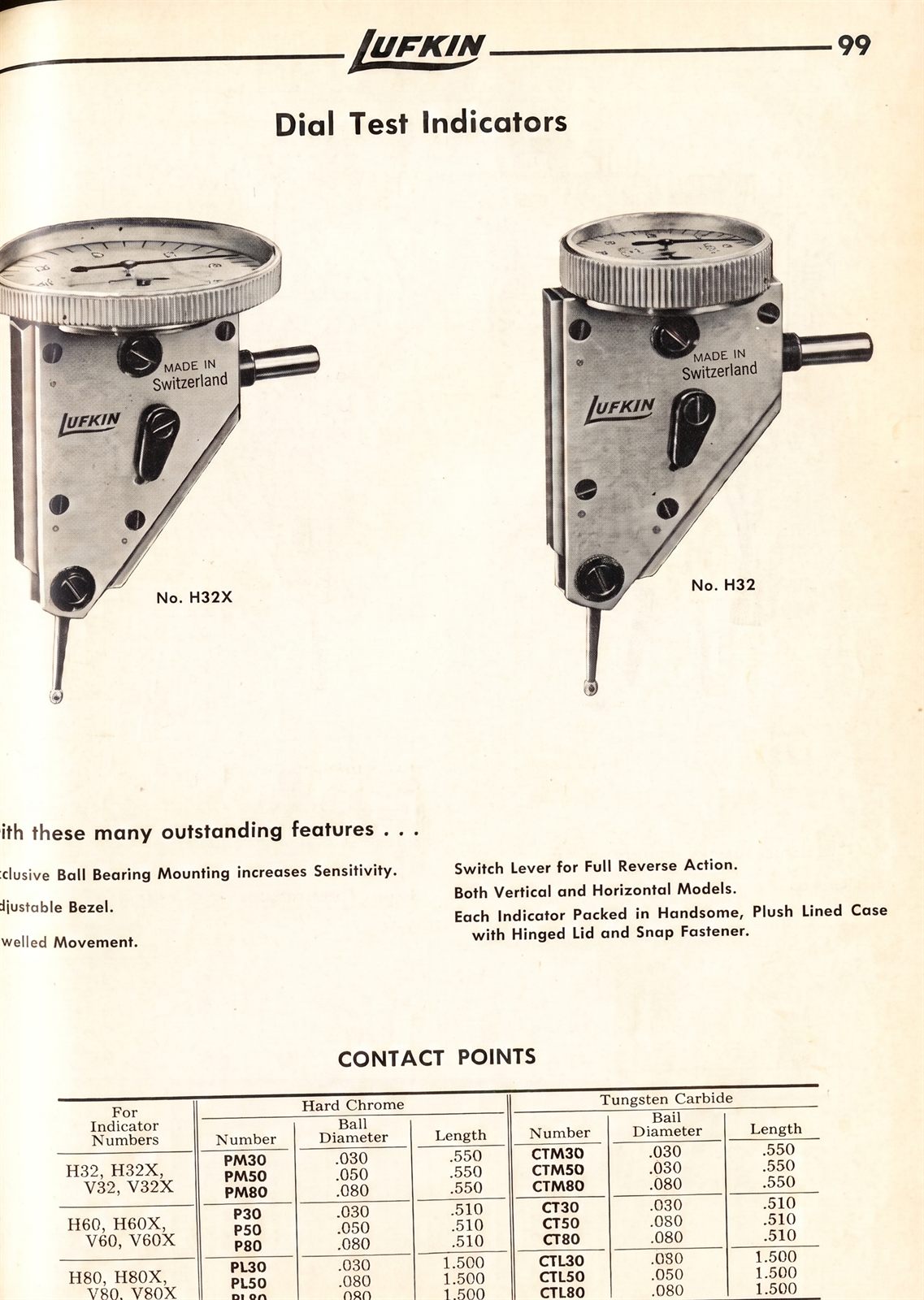
The catalog confirms the family features. The period Lufkin catalog (§3, first primary document) states them line-wide for the same instruments: bodies marked MADE IN SWITZERLAND, ball-bearing mounting, jeweled movement, adjustable bezel, a revolution counter on every model, a contact point that swivels 180°, a plush-lined case with a hinged lid and snap fastener, and a “Switch Lever for Full Reverse Action” — a reversing lever whose behavior anchors the range thesis (§5) and must be reconciled with the Chappuis patent at teardown (§3, Q15).
Institutional memory. The last known concentration of Alina knowledge is Long Island Indicator Service, whose principal produced the spare-parts documentation for both Alina and Compac indicators during the brands' working lives. Whether that documentation survives and is accessible is an open thread (Q10, direct inquiry Q5). A Chicago-area distributor's NOS point inventory is the only other period-derived data located to date. Likely — Long Island Indicator self-description; single-source.
This file covers the K- and M-series lever-type test indicators of the Compac (Geneva) lineage, produced c. 1950s to the mid-1960s, under all brand marks they carried in the US market — Alina primarily, with later-branded examples of the same models (e.g. Lufkin) in scope as census evidence. Both period bounds are approximate and under active investigation (§3).
The Alina name also covered plunger-type dial indicators (M46, M50 — both .0001") and the W-series dial bore gages. These are different instrument types outside this file's scope; they are noted here so the census isn't mistaken for the full Alina line — and as a caution that an “M” designation alone does not identify a lever test indicator.
Out of scope: the IXL series that succeeded these models, the redesigned modern Compac line, and current TESA / P-Line production — covered by existing reference material. One caution is exported to that material (REF-STY): modern Compac point and parts data does not apply to the instruments covered here.
The working bounds — c. 1950s to mid-1960s — are inherited, not established: the end bound rests on Long Island Indicator's statement that the K and M series were discontinued in the mid-1960s, and the start bound is so far only a general impression of the brand's US-market era. Tightening both is treated here as a research finding in its own right, pursued through evidence classes that each produce a hard date:
- Dated trade advertising — period issues of the American machine-trade press (American Machinist, Machinery, and peers) are partially scanned in public archives; a dated Alina advertisement or distributor announcement gives a firm not-later-than for market entry, and the last traceable ad brackets the exit.
- Period catalog — the Lufkin catalog (pp. 98–99, §4/§6) is the first primary period document in the file; if its edition/date can be fixed (Q14), it becomes a hard anchor for the Lufkin-branded era.
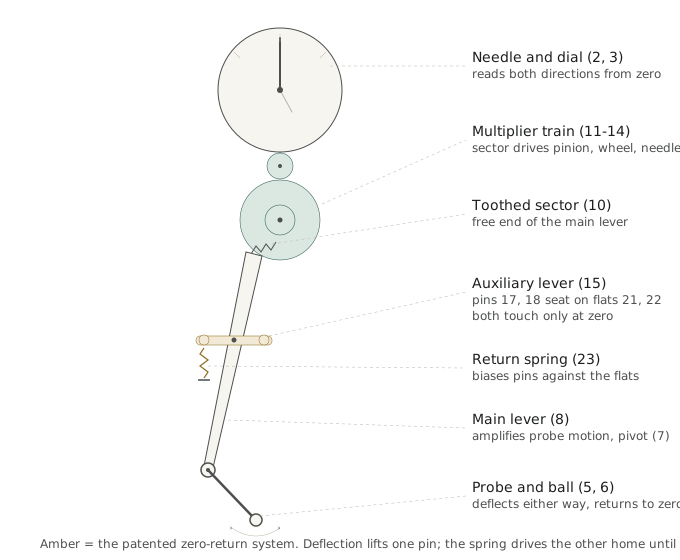
- Patent evidence — a “pat pending” marking on a specimen dates it before grant; a patent number dates it after. Identifying the underlying patents also names inventors and assignee, which bears on the importer question (§1). Current anchor: CH377111A (Chappuis, assignee Compac Fabrique d'Appareils de Mesure, filed 1962-01-25, published 1964-04-30) — a bidirectional fixed-zero mechanism (see below). One census M31 carries “pat pending” on the dial with no number (which unit — Alina or V32X — to be confirmed at the bench); the H80X (listing-attested) carries “PATENTED.” If both markings reference the same family, the pair self-sequences: pendency-marked units c. 1962–64, PATENTED units after April 1964. Hypothesis pending exact dial transcriptions + a US-family check (Q12). Caution: no US family member of CH377111A has been located; an English “pat pending” on a US-market dial usually implies a US application — either it exists unlinked, or the marking loosely referenced the Swiss filing.
- Specimen evolution — serials, dial signatures, case labels, packaging across accumulated specimens, ordered into a relative sequence and pinned wherever an absolute date attaches. Current data: the M31 body carries no patent number; branding macro comparison (ALN-M08/M09) pending.
- Distributor traces — dated catalog appearances, price lists, the NOS inventory's provenance.
Each dated find enters the timeline with its evidence chip; the section maintains a current best bracket. Likely current bracket: entry unknown / exit mid-1960s, single-source.
The Chappuis mechanism, and why it sits here rather than in §5. CH377111A describes a probe movable in both directions from a mechanically fixed zero, with no reversing lever: the main lever's toothed sector drives the multiplier train, and an auxiliary lever carries two spring-loaded pins that seat on their flats only at zero, returning the needle home from either direction. That is a genuinely elegant zero-return system — but it does not match what four units on the bench actually do (§5): they indicate one direction at a time and use a reversing lever to select direction. The patent therefore likely describes a different or successor design — plausibly the two-way IXL / modern-Compac movement — and the “pat pending” on the M31 dial may reference some other filing. The schematic below is drawn from the patent text only; verifying it against the Espacenet figures, and against an actual M31 teardown, are REV B items (Q12, Q13, Q15).
Two card styles: full cards for specimen-backed or catalog-specified models, dashed stubs for models attested by at least one sourced fact. Never name-only.
Specimen-backed
M31 — Alina (CPX-002) + Lufkin V32X (CPX-003) — vertical Provisional, per V32X decode
- Graduation .0001" — on the dial
- Dial magnification .002" per 180° → .004"/rev
- Range .032" per direction (Established, bench n=4). Owner dial arithmetic read this as ±.032"/side before the reversing-lever behavior was understood; the number is the same either way (§5).
- Revolution-counter subdial 0–7 — both units
- “pat pending,” no number, on the dial of one unit — which unit to be confirmed (marking Established; attribution Open)
- No patent number on the Alina M31 body
- CPX-002 acq. ~$50 (Ilya's founding specimen, §1); CPX-003 = Lufkin-branded counterpart, externally identical, internals unverified — comparative teardown queued (Q11/Q13). Verify the 1-9/16" dial on the unit (X class).
K25 — Alina (CPX-001, INBOUND) — purchased 2026-08-14, $65, eBay “The Household Toolbox,” original fitted case
- Graduation .0005" — listing dial photo
- Dial 1.5" Likely — listing
- Contact: ~1.5" long point installed — matches the catalog 80-class factory standard of 1.500" (§6). The forum's “±.080"” reads as the literal 80-class spec.
- Mapping: K25 ↔ H80 / V80 class Hypothesis (strong) — the .0005" + 1.5"-contact signature is the 80 class. Alina's own digits do not follow the Lufkin range code (Q6/Q9b).
- Absent from the K-series Chicago NOS point listing (Established, by absence)
- On arrival: markings check (pat pending?), thread pitch-gauge, L1 both conventions, case-fit evidence, rig session
Alina K-series stubs (source: Chicago-area distributor NOS point listings unless noted)
- K22h — orientation horizontal? Provisional (suffix); point .030 ball × .510" Likely
- K24 — existence only: owner report, 2009 forum; absent from point listing
- K26 — point .030 × .510" Likely; seen WITHOUT suffix on a dial in a listing (feeds Q7: suffixes may be catalog-only)
- K28h — point .030 × .510" Likely
- K29v — orientation vertical? Provisional; point .030 × .510" Likely
Lufkin catalog line (period Lufkin catalog pp.98–99 — primary doc; specs Established on the catalog basis, no specimens except where noted)
The catalog decodes the Lufkin scheme completely (Q9a closed): {V | H orientation} × {32 | 60 | 80 range in thousandths, per direction} × {plain = 1" dial | X = 1-9/16" dial} — twelve models. V32X and H80X are the two that also appear in this file as physical/attested units.
| Model | Orient. | Range / direction | Dial | Note |
|---|---|---|---|---|
| V32 | vertical | .032" | 1" | catalog-attested |
| V32X | vertical | .032" | 1-9/16" | = Alina M31 (bench pair, CPX-003) |
| V60 | vertical | .060" | 1" | catalog-attested |
| V60X | vertical | .060" | 1-9/16" | catalog-attested |
| V80 | vertical | .080" | 1" | candidate K25 counterpart (Q) |
| V80X | vertical | .080" | 1-9/16" | catalog-attested |
| H32 | horizontal | .032" | 1" | catalog-attested |
| H32X | horizontal | .032" | 1-9/16" | catalog-attested |
| H60 | horizontal | .060" | 1" | catalog-attested |
| H60X | horizontal | .060" | 1-9/16" | catalog-attested |
| H80 | horizontal | .080" | 1" | candidate K25 counterpart (Q) |
| H80X | horizontal | .080" | 1-9/16" | listing unit (ALN-M12): .0005", 0-5-0, rev counter 0–7, “PATENTED” |
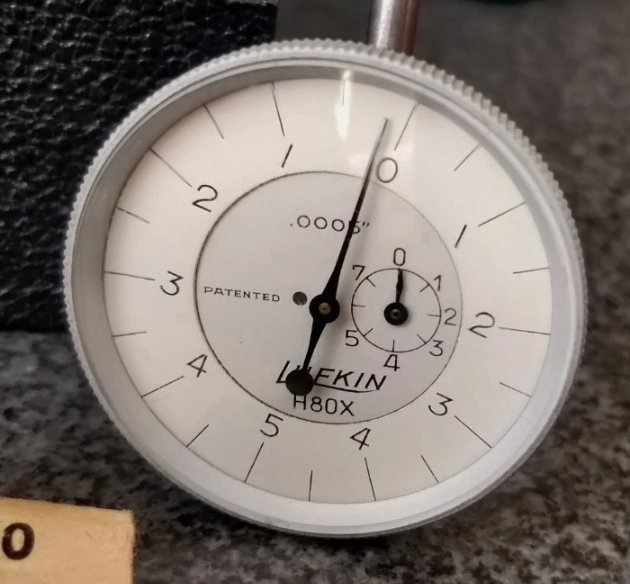
Cross-brand model-mapping table
| Alina | Lufkin | Parvus (Europe) | Basis |
|---|---|---|---|
| M31 | V32X | P3 (suspected — 0–0.8 mm ≙ ±.0315" if per-side) | bench pair — Established Alina↔Lufkin; P3 Hypothesis |
| K25 | H80 / V80 class | ? | Hypothesis (strong) — .0005" + 1.5" contact = 80 class |
| ? | H80X | ? | wanted |
Different-type note (not lever DTIs, no cards): M46, M50 (plunger, .0001", auction-attested); W28 bore gage (.80–2.00" × .0001").
The claim. These instruments carry measuring range far beyond the norms of their class. A typical .0001" lever test indicator — then and now — offers on the order of .008" total travel. The M31 in this census, by dial arithmetic, delivers .032" per direction: four times that baseline at minimum, on a tenths dial, and eight times it across the reversing flip. The modern Compac line's own marketing still leads with the family's “extended range” sixty years on. This section replaces arithmetic and anecdote with measured numbers.
Range convention — settled on the bench. Verified on four units in hand: the encoded range is per direction. These indicators indicate one direction at a time; a reversing lever selects the direction; each direction delivers the full encoded range. A “32” model reads .032" each way (a .064" envelope across the flip); an “80” model reads .080" each way. Established (bench, n=4). The thesis holds under any reading — at minimum four times the class baseline.
The architecture. The range comes not from one trick but a coordinated design, each element requiring the others:
- High dial magnification — the M31 spreads .002" across 180° of face, reading generosity most makers never attempt, which forces multi-revolution travel.
- A revolution-counter subdial — 0–7, eight revolutions per direction, to make that travel readable (attested on the M31 and the Lufkin H80X).
- A reversing lever — the catalog's “Switch Lever for Full Reverse Action” selects direction so each side delivers the full encoded range. This is the third structural element (replacing the Chappuis fixed-zero reading, which the bench units do not exhibit — §3).
Together they read as a deliberate design philosophy, not a specification accident.
The decoder. Lufkin's scheme is fully readable from the catalog (Q9a closed): orientation + range-in-thousandths-per-direction + dial-size letter. Alina's own digits appear to track a related quantity but do not follow the Lufkin range code — the earlier M31↔V32X “31≈32” coincidence now looks metric-derived or accidental, and Alina's letter/digit encoding stays open (Q9b). Under the catalog, the K25's .0005" + 1.5" long contact is the 80 class outright: the odd probe, the “±.080"” anecdote, and the model all resolve as the factory 80-class configuration in one stroke.
Measurement protocol. Per specimen, on the calibration micrometer rig: total travel per direction to hard stop; per-revolution displacement against the dial's claim; symmetry across the reversing flip; rev-counter direction behavior; for long-contact configurations, tip travel at measured arm length vs movement travel. Comparison set measured identically: Interapid 312, Brown & Sharpe BesTest, modern Compac, Mitutoyo 513 — the family against its Swiss contemporaries, the modern lineage, and the volume import that ended the era. (Q1 now narrows to per-model measured values and counter behavior — the convention is settled.)
What would falsify it. Rig numbers materially under the dial arithmetic, or comparison instruments showing the era's norms were broader than the ~.008" baseline assumed here.
Alina K/M-era (Chicago NOS listings). K-series points .030" ball × .510" length; M-series .080" × .545". Likely — period NOS listings; the K25 is absent from both. The K25's 1.5" long contact is factory 80-class (below).
Thread. UNKNOWN for the K/M era. Modern Compac M1.6 × 0.35 does not carry backward (an era split; this caution is exported to REF-STY's Compac section at its next revision). Pitch-gauge every specimen (Q2).
Lufkin catalog contact table (primary doc, Established). Ball diameters .030 / .050 / .080 across all lengths; hard chrome and tungsten-carbide variants share the pattern:
| Length / class | Hard chrome | Tungsten carbide | Length |
|---|---|---|---|
| 32-class | PM30 / PM50 / PM80 | CTM | .550" |
| 60-class | P30 / P50 / P80 | CT | .510" |
| 80-class | PL30 / PL50 / PL80 | CTL | 1.500" |
The K25 (.0005", 1.5" contact) maps to the PL / CTL 80-class standard — which substantially closes Q3; the residual is confirming the K25's specific point against the PL/CTL dimensions on arrival. Cross-check (Q16): the .510" and .545" lengths appear in both the Lufkin catalog and the Chicago NOS Alina-era data — likely the same physical parts across the two brand eras. Open.
Sources. Long Island Indicator Compac repair page (history + institutional memory; approved source authority per standing policy); the period Lufkin catalog pp. 98–99 (first primary period document; edition/date pending, Q14); Chicago-area eBay distributor NOS Alina point listings (period-derived); Practical Machinist threads (2006, 2009, 2013 — anecdotes, incl. the K25 “±.080” claim and Long Island Indicator quotations); Google Patents CH377111A (primary patent document — per library rule, the patent number is backed by this primary doc); Worthpoint / auction records (M46, M50, W28, K26, Parvus P3GA attestations); eBay listing (Lufkin H80X, ALN-M12, use permission granted); Ilya's specimens (primary).
Search log (the “not located” claims in §0 rest on these; dated 2026-08-14): web searches for Alina K25 point specs, vintage Tesatast rev-counter generation, and Compac / Parvus patents & catalogs — no factory catalog, parts chart, or K/M spec sheet located as of this writing.
- Q1 — K25 + M31 measured range on the rig (per-model measured values per direction, symmetry, per-rev displacement, counter behavior) Open
- Q2 — K/M-era contact thread ID (pitch-gauge specimens) Open
- Q3 — K25 long-contact factory status — substantially closed (catalog 80-class standard 1.500"); residual: confirm the K25's specific point vs PL/CTL dims
- Q4 — does the K25 appear in any period point chart Open
- Q5 — Long Island Indicator direct inquiry: do the Meyer-era Alina parts lists survive / are they available Open
- Q6 — what the K vs M series letters encode Open
- Q7 — h/v suffix convention: dial-marked vs catalog-only (K26 seen unsuffixed) Open
- Q8 — production-period bracketing (dated ads, catalog edition, patents, specimen evolution) Open
- Q9a — Lufkin digit decoder — CLOSED by the catalog (range/direction + dial-size letter)
- Q9b — Alina letter/digit encoding Open
- Q10 — do period Alina catalogs / parts charts survive anywhere (Q5 is one avenue) Open
- Q11 — cross-brand model survival & mapping: internal identity of the M31/V32X pair; sequence evidence Open
- Q12 — US counterpart of CH377111A (Espacenet / Global Dossier family check; exact dial-text transcriptions) Open
- Q13 — does the Chappuis mechanism match the M31 internals (comparative teardown; if not, ALN-M16 stays in §3) Open
- Q14 — Lufkin catalog edition/date + source citation (pending Ilya) Open
- Q15 — reversing-lever direction-selector vs Chappuis fixed-zero reconciliation Open
- Q16 — do Lufkin PM/P/PL part numbers = the Chicago NOS Alina-era parts physically (lengths .510 / .545 / .550 reconciliation) Open
Vintage TESA test indicator, “PAT PEND” on dial, revolution-counter subdial, .0001" — eBay listing 2026-08-14 (item 318688848350, “Tesa .0001 Test Indicator,” $80 OBO, seller sogse47); generation not matching any documented modern Tesatast; the same multi-rev extended-range architecture as the census instruments. Evidence that the design school spanned at least two Genevan / Swiss houses. Cross-reference only; an escape hatch to a future “period Swiss extended-range DTI” file.
Generated at load from the media slots above — one source of truth. 0 planned items — . Status vocabulary: needed / shot / placed / on-file / generated-at-build / wanted.
| ID | Content | Type | Size / aspect | Status |
|---|